
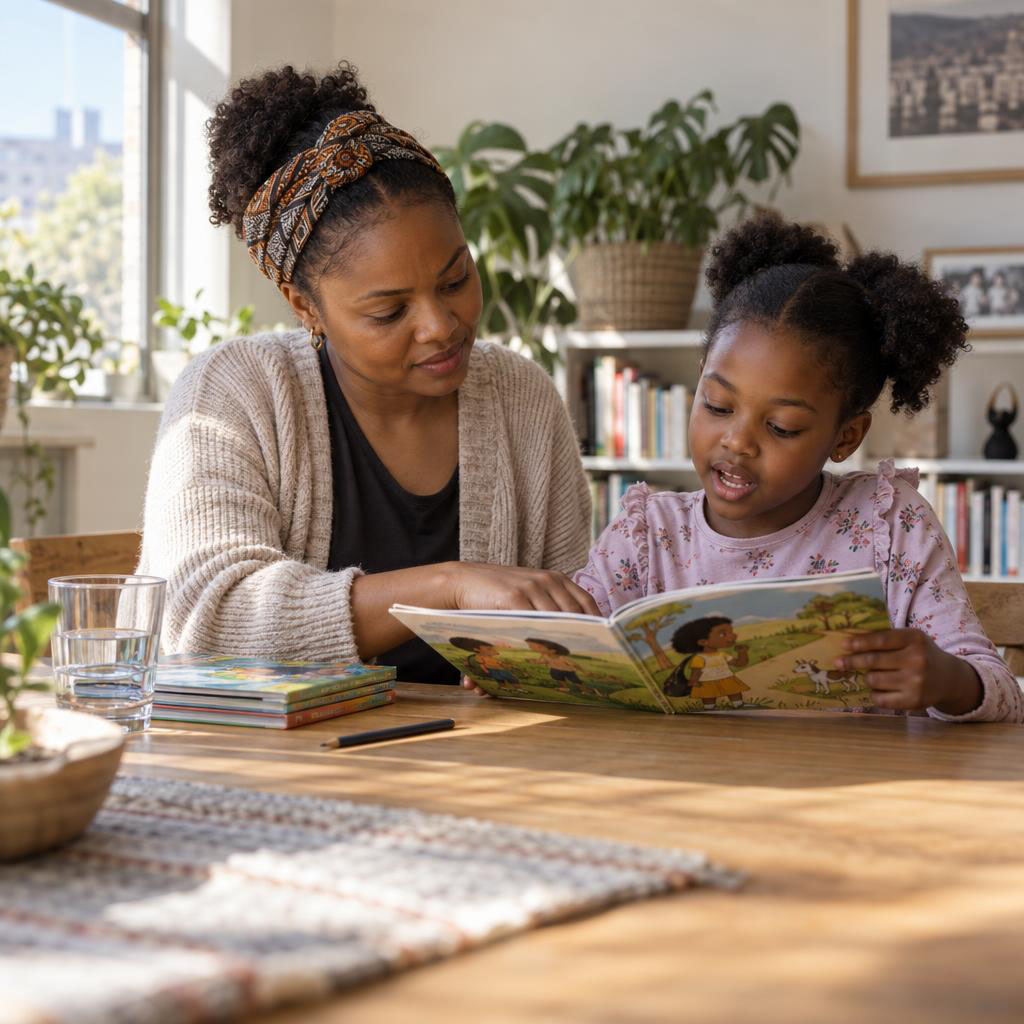
If you are teaching a child to read in Grades R to 3 in South Africa, start with the material the Department of Basic Education already publishes for free. Add Funda Wande's teacher videos if the child reads in an African home language. Get the books from Nal'ibali, African Storybook and Vula Bula. For your own training, Funda Wande's SACE-accredited academy and Reading Rockets' Reading 101 cost nothing, while UNISA and Macmillan charge. For a child who still needs to be taught to read, rather than practise reading, someone has to do the teaching: a live-taught course such as CambriLearn's 24-week Learning to Read and Write, or a scripted programme you run yourself, such as UFLI Foundations.
"Best" in this guide means four things: an evidence base, a fit with the CAPS Foundation Phase curriculum, coverage of the language your child reads in, and a clear answer to who does the teaching. Every resource below is judged on those four. The short version comes first, then the full comparison, then a weekly routine you can copy.
Why the Foundation Phase decides whether a child reads at all
The Foundation Phase covers Grades R to 3, the four years in which South African children are meant to learn to read before Grade 4, when the curriculum switches to reading to learn. Most children do not get there. In PIRLS 2021, 81% of South African Grade 4 learners could not read for meaning in any of the 11 official languages, up from 78% in 2016 (Department of Basic Education, PIRLS 2021: South African Preliminary Highlights Report, May 2023). The study tested 12,426 Grade 4 learners between August and November 2021. South Africa's average score of 288 sat far below the international centre point of 500.
The same department has shown what closes the gap. In its Early Grade Reading Study, Grade 1 and 2 teachers in no-fee North West schools who received structured lesson plans, Vula Bula graded readers in Setswana and on-site coaching lifted their learners' reading by roughly 40% of a year of learning over two years, compared with schools that received nothing (Department of Basic Education, EGRS I Wave 3 Report, 2018). In those control schools, close to 40% of Grade 2 children could not read a single word of a short paragraph.
Two things did the work there: structured lessons with books written for decoding, and a coach checking how the teaching went. Keep that in mind as you read the list. The resources below either fit that pattern or they do not.
What "teaching reading" means in the CAPS Foundation Phase
CAPS, the Curriculum and Assessment Policy Statement, is the national curriculum the Department of Basic Education mandates for Grades R to 12. In Grades 1 to 3 it allocates seven to eight hours a week to Home Language, and inside those hours sits a daily Reading and Writing Focus Time of about an hour. The department's Grade 1 English Home Language teaching plan sets out how that hour runs: 15 minutes of shared reading and shared writing, about ten minutes of phonics and word work, then group guided reading, with the teacher taking two ability groups a day for 15 minutes each (Department of Basic Education, Revised National Teaching Plan, English Home Language Grade 1).
Underneath the timetable are five skills. Phonemic awareness is hearing and playing with the separate sounds in spoken words. Phonics is linking those sounds to letters so a child can decode print. Fluency is reading accurately at a natural pace. Vocabulary is knowing what the words mean. Comprehension is understanding the text as a whole. The US National Reading Panel named these five in 2000, UNISA teaches them as the "five critical areas" in its Foundation Phase reading courses, and CAPS builds its teaching plans around them. Our guide to the types of reading skills goes deeper on each.
The department has also put a number on early progress. By the end of Grade 1, a child learning in a Nguni, Sesotho-Setswana or Xitsonga home language should correctly sound 40 letters a minute (Department of Basic Education, Early Grade Reading Benchmarks, 2023). Letter-sound speed stalls around that point, which is the signal to move phonics time onto blending and word attack.
One distinction organises everything that follows. A storybook library builds vocabulary, listening comprehension and the habit of reading. It does not, on its own, teach a child to decode. Phonics instruction and guided reading with an adult do that. Several of the free resources below are libraries. Treat them as the books in the routine, and make sure something else is doing the teaching.
Every resource compared
Seventeen resources for teaching reading in the Foundation Phase, compared on what each one is, who it suits, the language it covers, what it costs and who does the teaching. Details and prices were checked in September 2026.
Free South African resources for Foundation Phase reading
Department of Basic Education storybooks and readers. The DBE, with the National Reading Coalition and the National Education Collaboration Trust, has published 21 Foundation Phase Home Language storybooks in isiXhosa, Sepedi, Siswati and Tshivenda, free to download from the department's Stories for the Foundation Phase page. The NRC's own library at nrc.org.za adds more African-language titles. Use them for shared reading and read-alouds. The phonics has to come from somewhere else.
DBE reading framework, Early Grade Reading Study materials and benchmarks. The department publishes the EGRS reports, the reading benchmarks for African languages and the National Framework for the Teaching of Reading in African Languages in the Foundation Phase (2020). The framework is the closest thing South Africa has to an official method: teach the five vowel sounds first, one a day, and integrate letter recognition with handwriting from the start. Free, and written for teachers rather than parents.
WCED ePortal Foundation Phase virtual library. The Western Cape Education Department's ePortal holds a free online library of Grade R to 3 readers, including English Home Language reading-for-enjoyment storybooks and titles in other official languages. You do not need to live in the Western Cape to use it.
Funda Wande. Funda Wande is a not-for-profit that trains Grade R to 3 teachers to teach reading for meaning in African home languages. Its teacher videos, lesson materials and 12-unit Reading for Meaning course are free under Creative Commons licences, and its online Reading and Numeracy Academy carries SACE accreditation, so the professional development points count. Two limits matter. Funda Wande is an African home-language programme: its English versions exist for reference, and it does not provide phonics lessons in English. If your child reads in English, use it to understand the method and get the phonics elsewhere.
Nal'ibali. Nal'ibali (isiXhosa for "here's the story") is South Africa's national reading-for-enjoyment campaign, launched in 2012 by PRAESA and the DG Murray Trust. It publishes free stories in all official languages, in print, audio and video, plus bilingual newspaper supplements and activity guides, and it trains adults to run reading clubs. WhatsApp the word "stories" to 060 044 2254 for stories on your phone. Nal'ibali builds the reading habit and the spoken language a child brings to decoding. It does not teach phonics.
African Storybook. African Storybook, run by the Johannesburg non-profit Saide since 2014, publishes openly licensed picture storybooks for children aged two to ten. The free African Storybook Reader app holds more than 1,500 approved storybooks across 40 African languages, graded into five reading levels from first words to read-aloud, and works offline once downloaded. For levelled books in South African languages, start here. A Grade 1 child can read Level 1 and 2 titles alone once decoding has started.
Vula Bula. Vula Bula is a graded reader series for Grades 1 to 3, written in isiXhosa first and versioned into eight other official African languages, rather than translated from English readers, and published under a Creative Commons licence so schools and parents can print them. These are the readers the DBE used in the Early Grade Reading Study. When the Eastern Cape issued isiXhosa Vula Bula anthologies to every Foundation Phase learner in 2019 and 2020, reading outcomes improved against earlier cohorts in the same schools (Ardington and Spaull, 2022). The Molteno Institute, the original publisher, closed in 2024; the series now lives at vulabula.org.za. If your child decodes in an African language, this is the practice material.
Wordworks. Wordworks is a Cape Town literacy organisation whose Stellar programme gives Grade R teachers a full year of home-language early literacy in two-week story cycles: 38 weeks of daily story-based activities and letters-and-sounds work, built around 19 stories from Book Dash, African Storybook and Nal'ibali. It is CAPS-aligned, the teacher training is SACE-endorsed, and the year pack of big books, little books and activity guides exists in every written South African language. Training is paid; graduates download the resources free. Wordworks also holds the Shine Literacy Hour materials for Grade 2 and 3 English reading support.
Room to Read Literacy Cloud. Literacy Cloud is a free digital library of children's storybooks created by authors and illustrators in Room to Read's programme countries, downloadable for offline reading, alongside short training videos for teachers on running reading time. English titles dominate. Treat it as a supplement rather than a South African curriculum resource.
Online courses that teach adults to teach reading
Funda Wande Reading and Numeracy Academy. The free option with SACE accreditation. Video-led, built for South African Foundation Phase classrooms, and the only course on this list that models lessons in African home languages. The note above about English applies.
Reading Rockets Reading 101. Reading Rockets, a US public-media literacy project, runs Reading 101 as nine free online units you complete independently: print awareness, phonological and phonemic awareness, phonics, fluency, vocabulary, spelling, comprehension, writing and assessment. Each unit ends in a short test and a downloadable letter of completion. It was built with the Center for Effective Reading Instruction and the International Dyslexia Association, and it explains the five skills more clearly than anything else on this list. It is written for American teachers in English, so you will map it onto CAPS yourself.
UNISA Reading in the Foundation Phase. UNISA offers Reading in the Foundation Phase as a year-long online subject inside its BEd in Foundation Phase teaching, in English (RFP2601), Setswana (RFP2602), Sepedi (RFP2603) and Afrikaans (RFP2607). It covers the five critical areas of reading instruction and the techniques for teaching them. This is the route if you want a qualification and university credit. It carries UNISA fees and an academic year's commitment.
Macmillan South Africa Foundation Phase workshops. Macmillan runs short online workshops for practising teachers, including one that walks through teaching reading in the Foundation Phase step by step, from phonemic awareness through reading strategies to comprehension, and others on shared and group guided reading, phonics, and sight words and vocabulary. Practical and CAPS-referenced. Pricing is on request.
Programmes that teach a child to read
CambriLearn Learning to Read and Write. Learning to Read and Write is a 24-week CambriLearn course for children aged five to six, taught in weekly live online lessons by a Foundation Phase teacher. It takes the approach used in newer phonics programmes: children learn letters and blends together from the first week rather than all 26 single letters first, so they read their first words in Week 2. Sight-word work starts in Week 20. Lessons are recorded, and the published fee is from $290 a year (course page, September 2026). It is the entry point to CambriLearn's CAPS Grade 1, which requires a child to be reading. Choose it when you want a qualified teacher doing the teaching and you do not want to run a scripted programme yourself.
UFLI Foundations. UFLI Foundations, from the University of Florida Literacy Institute, is an explicit, systematic phonics programme of 148 scripted lesson plans. The manual costs about US$70 plus shipping from Ventris Learning; the online toolbox of slide decks, decodable passages and home-support sheets for every lesson is free. It is English-only and written for American classrooms. With 148 scripted lessons it is the most complete programme on this list for a parent to run at home, provided you are prepared to teach a 30-minute lesson four or five days a week.
Jolly Phonics. Jolly Phonics is a British synthetic phonics programme that teaches 42 English letter sounds, each with an action, before moving on to blending and tricky words. It is common in South African primary schools (Google records about 2,900 local searches for it a month), so a child moving between home and a classroom will often meet the same sounds and actions in both. Materials are paid, and it is English-only.
Reading Eggs. Reading Eggs is an online reading programme for ages two to 13 with guided phonics lessons, games and a library of more than 4,000 e-books. The South African site offers a 30-day free trial and then US$9.99 a month for up to four children (readingeggs.co.za, September 2026). It is English-only and not aligned to CAPS. It works as daily practice once a child can decode, and it does not replace a person teaching phonics.
Saving Grace Learn to Read. Launched in mid-2026, Saving Grace Learn to Read is a CAPS-aligned set of online phonics lessons, graded readers and reading tests for Grades R to 3, with a Grade 4 to 6 Reading Booster for older children who missed the basics. The Literacy Learner Path costs from R149 a month, and the first two lessons of every grade are free without a card. The child works through the lessons alone, so an adult still has to sit alongside and check the decoding.
How CambriLearn teaches reading in Grades R to 3
CambriLearn is an accredited online private school for ages 4 to 19, with live timetabled lessons taught by specialist teachers. In the Foundation Phase that means Grade RR (ages four to five), Grade R, Learning to Read and Write, and CAPS Grades 1, 2 and 3. It is accredited by Cognia and Pearson Edexcel; registered with SACAI and IEB; NCAA approved.
Grade R children attend weekly live lessons in Literacy and Mathematics and work through the Tippie Learn to Read Level R boxed set, the South African graded series on CambriLearn's Grade R book list. Learning to Read and Write runs the 24-week blends-first course described above. CAPS Grade 1 requires a child to be reading on entry, through that course or an equivalent, and then teaches English Home Language, Afrikaans First Additional Language, Mathematics and Life Skills through a structured lesson plan for each subject, weekly live lessons per subject, a recorded lesson library, and assignments marked by the child's teacher with individual feedback. Parents follow progress on the Student Tracker. Families on the Premium package add a weekly 30-minute question-and-answer session and direct teacher chat during school hours.
Parents of Foundation Phase children sit with their child during lessons and reading practice. The teaching is done by the school; the routine at home is yours, and our guide to online primary school in South Africa sets out what that involves day to day. CambriLearn has taught more than 80,000 students across 100-plus countries over 20 years and holds a 4.8-star average from 386 reviews across Google, HelloPeter, Trustpilot and Facebook (checked 10 September 2026).
If you want to talk through where your child is with reading before choosing a grade, book a consultation with an academic consultant.
How to choose, by situation
You homeschool a five- or six-year-old in English. Get the teaching from a person: CambriLearn's Learning to Read and Write if you want a teacher, or UFLI Foundations if you will teach it yourself. Add Reading Rockets Reading 101 for your own understanding, and use African Storybook's English Level 1 and 2 titles and the WCED ePortal for books.
Your Grade 2 or 3 child is behind. Go back to sounds. The DBE benchmark is 40 letter sounds a minute by the end of Grade 1, so test that first with a page of mixed letters and a timer. If letter sounds are slow, restart phonics with a scripted programme. If letter sounds are fine and blending is not, use Vula Bula or African Storybook Level 1 readers in the child's language for ten minutes a day. Saving Grace's Reading Booster covers this age group in English and is free to try.
You teach in an African home-language classroom. Funda Wande's academy for method, Vula Bula anthologies for decoding practice, the DBE's National Framework for the Teaching of Reading in African Languages for sequence, and Nal'ibali and African Storybook for the classroom library.
You are a student teacher or want a credential. UNISA's Reading in the Foundation Phase for the qualification. Reading Rockets Reading 101 alongside it for the clearest explanation of the five skills, and the certificate for your portfolio.
A weekly home reading routine that mirrors CAPS
The DBE's Grade 1 plan gives you the shape. Run this four or five days a week and it comes to about 40 minutes.
- Shared reading, 15 minutes. You read a storybook aloud and talk about it. Nal'ibali, African Storybook and the DBE stories all work here. This builds vocabulary and comprehension.
- Phonics and word work, 10 minutes. One new sound or blend, three or four words built from it, and a quick run through yesterday's sounds. Follow whichever programme you have chosen so the sequence stays intact.
- Guided reading, 15 minutes. The child reads a levelled book at their own level to you, and you help with the decoding. Vula Bula or African Storybook Levels 1 to 3 suit this slot.
- Writing, two minutes. The child writes two or three of the words from step 2. CAPS pairs reading and writing because each reinforces the other.
Track two things: letter sounds per minute once a term, and the level of book the child reads alone. Both move when the routine is working. Whether a reading log adds anything on top is a separate question, covered in our guide to reading logs.
Frequently asked questions
What are the best free resources for teaching reading in the Foundation Phase in South Africa?
The Department of Basic Education's Foundation Phase storybooks and reading framework, the WCED ePortal library, Funda Wande's teacher videos and SACE-accredited academy, Nal'ibali's stories, African Storybook's 1,500-plus levelled books in 40 African languages, and Vula Bula's graded readers in nine official African languages. All are free. Only Funda Wande and the DBE framework teach method; the rest supply books.
Which online courses teach adults how to teach reading in the Foundation Phase?
Funda Wande's Reading and Numeracy Academy (free, SACE-accredited, African home languages), Reading Rockets Reading 101 (free, nine units, English, certificate of completion), UNISA's Reading in the Foundation Phase (a fee-paying university subject in English, Afrikaans, Setswana and Sepedi) and Macmillan South Africa's short online workshops for teachers.
Can a child learn to read through an online school?
Yes, if a teacher is teaching the phonics live and an adult sits with the child for daily practice. CambriLearn's Learning to Read and Write teaches five- and six-year-olds to read over 24 weeks of weekly live lessons, with children reading their first words in Week 2. Apps and video libraries on their own provide practice; the instruction has to come from a person.
Is Funda Wande suitable for teaching English Home Language?
No. Funda Wande is an African home-language programme. Its English materials are provided for reference, and it does not offer phonics lessons in English. For English phonics use a scripted programme such as UFLI Foundations or Jolly Phonics, or a live-taught course.
How much reading time does CAPS expect in Grade 1?
CAPS allocates seven to eight hours a week to Home Language in Grades 1 to 3, with a daily Reading and Writing Focus Time of about an hour: 15 minutes of shared reading and writing, about ten minutes of phonics, and group guided reading in two 15-minute ability groups a day.
My Grade 2 child cannot read yet. Where do I start?
Check letter sounds first. The Department of Basic Education's benchmark is 40 correct letter sounds a minute by the end of Grade 1. If your child is below that, restart systematic phonics daily. If sounds are secure, the gap is blending, and ten minutes a day with Level 1 graded readers in the child's language, read aloud to you, is the fix.
How can you teach reading in the Foundation Phase?
Teach the five skills in a daily routine: phonemic awareness and phonics for about ten minutes, shared reading for 15 minutes, guided reading at the child's level for 15 minutes, and a few minutes of writing linked to the sounds taught. Follow one systematic phonics sequence rather than mixing programmes, use graded readers for practice, and check letter-sound speed and reading level each term against the Department of Basic Education's benchmarks.
Do reading apps like Reading Eggs teach a child to read?
They drill phonics well enough for practice. They do not replace an adult who hears the child read, corrects decoding errors and adjusts the next lesson. Use them for the practice slot in the routine, not the teaching slot.
What does my child need to know before starting CAPS Grade 1 at CambriLearn?
Grade 1 entry requires that the child can read, either through CambriLearn's Learning to Read and Write course or an equivalent. If you are unsure, an academic consultant can arrange an assessment to place your child at the right level.