
IGCSEs are the qualifications that decide whether your A Level options stay open. They are also the qualifications that, more than any other stage of school, reward students who learn how to study properly. Get this right at 14 to 16, and the habits will carry through every exam that follows. Get it wrong, and the gaps show up later in ways that are much harder to fix.
This guide is written for students taking IGCSEs through an online school, through distance learning, or as private candidates studying at home. It covers the practical questions: how many hours a day, how to balance subjects, how to revise, when to start using past papers, and what to do when you fall behind. The principles apply whether you are studying full-time from home or fitting IGCSEs around other commitments such as travel, sport, or part-time work.
Why Home Study Works Well for IGCSEs
Students sitting IGCSEs at home often outperform their classroom peers, particularly in the upper grade bands. The reasons are structural. At home you can go at your own pace on each topic rather than the average pace of a class. You can spend longer on the subjects you find difficult and move faster through the ones that come easily. You are not pulled along by a teacher who has to keep thirty students moving together.
The Sutton Trust's research on disadvantaged but high-achieving students found that students who spent significant amounts of time on homework daily in Year 11 were nine times more likely to get three A-levels than those who did no regular homework. The finding extends a broader point: dedicated, focused independent work outside the classroom is one of the strongest predictors of academic success. Home study, done well, structures the entire day around exactly that.
The trade-off is that you lose the external scaffolding a school provides. No bell tells you the lesson is over. No teacher chases the homework you missed. No peer comparison shows you where you stand. The students who do well at IGCSE from home are the ones who replace that external structure with internal structure of their own.
Build a Sustainable Daily Routine
A workable IGCSE home routine looks different from an A Level one. IGCSE students are typically 14 to 16, which means concentration spans are shorter, screen fatigue arrives faster, and routines need more variety. Most successful home-study IGCSE students put in three to five hours of focused study on weekdays during normal term, with weekends used for catch-up, lighter consolidation, or genuine rest.
Break the day into shorter blocks than you would for A Levels. Forty-five minutes of focused work followed by a fifteen-minute break is a common pattern. Three to four such blocks across the day, scheduled at times when your concentration is best, deliver more learning than longer sessions that drift. Rotate subjects across the week so you are not doing six hours of Maths followed by no Maths for a fortnight. Most teachers recommend touching every active subject at least twice per week, even briefly.
Build in a weekly review session. One block, once a week, spent looking back at what you have covered and identifying weak spots. Without this habit, gaps quietly compound across the year. Students who do this consistently arrive at the exam term knowing exactly what needs more work.
Use Active Methods, Not Passive Reading
The most common mistake home-study IGCSE students make is reading and re-reading the textbook and calling it studying. It feels like work because you are putting in time. The problem is that the information is not being retrieved, only recognised, so it does not transfer reliably into long-term memory.
Active study methods are the ones that force you to recall information without looking at it. Practice questions are the most powerful technique by some distance. After learning a topic, close the book and write a summary from memory. Make flashcards for vocabulary, formulas, dates, and definitions, and test yourself daily. Try teaching the topic out loud to a family member or even an empty room. If you cannot explain it clearly, you do not yet know it.
Spaced repetition is the other technique that pays off enormously across an IGCSE year. The content you learn in October needs to be in your head in May or June. Reviewing each topic at gradually expanding intervals, after a day, then a week, then a month, embeds information far more durably than concentrated cramming in the weeks before exams.
Strategies by Subject Type
Different IGCSE subjects reward different study approaches. Sciences such as Biology, Chemistry, and Physics combine memorisation of facts and processes with applied problem-solving. The most effective approach combines flashcards for definitions and equations with regular practice questions on application. Drawing and labelling diagrams from memory is particularly effective for Biology.
Mathematics is built almost entirely on practice. Reading a Maths textbook teaches you very little; doing the questions teaches you nearly everything. Work through every question in the textbook for each topic, then move to past papers as soon as you have covered enough content. Identify the question types you find hardest and drill them specifically. Mathematics rewards consistent daily practice more than almost any other subject.
Languages and humanities reward sustained reading combined with structured writing practice. For English Literature, study the set texts in depth and write practice essays under timed conditions, marked against the mark scheme. For History, build a clear chronological framework first, then layer in detail and analysis. For modern languages, daily vocabulary work plus speaking practice with someone or even with audio recordings produces results that occasional intensive sessions do not.
Start Past Papers Earlier Than Feels Natural
Past papers are the most useful resource you have. Most students treat them as revision in the final term. This is too late. From the moment you finish a topic, you should be working through past paper questions on that topic. Working topic-by-topic through past papers as you study consolidates content and shows you what examiners actually ask before exam pressure builds.
By the spring of the exam year, you should be moving to whole past papers under timed conditions. This builds exam stamina, which is its own skill. A student who can produce strong answers in a relaxed practice session may struggle to do the same under timed pressure if they have not built up to it. Mark schemes deserve as much attention as questions; reading them systematically teaches you what the awarding body actually rewards.
CambriLearn supports IGCSE preparation through the International British Curriculum, with structured pathways covering each subject area and degree-qualified educators delivering both live and recorded content. For students working toward IGCSE qualifications, the combination of structured teaching and the freedom to study independently when needed often produces stronger outcomes than purely solo study.
Manage Distraction Honestly
Where you study and how you manage distractions matter more at 15 than at 18. Phones are the biggest single threat to home study at this age, and willpower alone is rarely enough. The most successful home-study IGCSE students treat phones as a tool for breaks, not for study blocks, and physically leave them in another room while working. Notifications, even brief glances, fragment concentration in ways that take significant time to recover from.
A consistent study space helps. It does not need to be a whole room: a desk in a quiet corner with study materials laid out and nothing else is enough. The key is that it is yours, it is consistent, and it has minimal friction to start working when you sit down.
Sleep, food, and exercise are the unglamorous factors that affect home study more than most students realise. Skipping sleep to study more is almost always counterproductive at this age, because the consolidation of learning happens during sleep itself.
Plan the Exam Year Properly
IGCSEs run on a one-year final cycle, with most exams in May and June. From January of the exam year, your study should be shifting from new content to consolidation, weak-area drilling, and exam technique. The final eight to ten weeks should be heavily focused on past papers and revision rather than new learning.
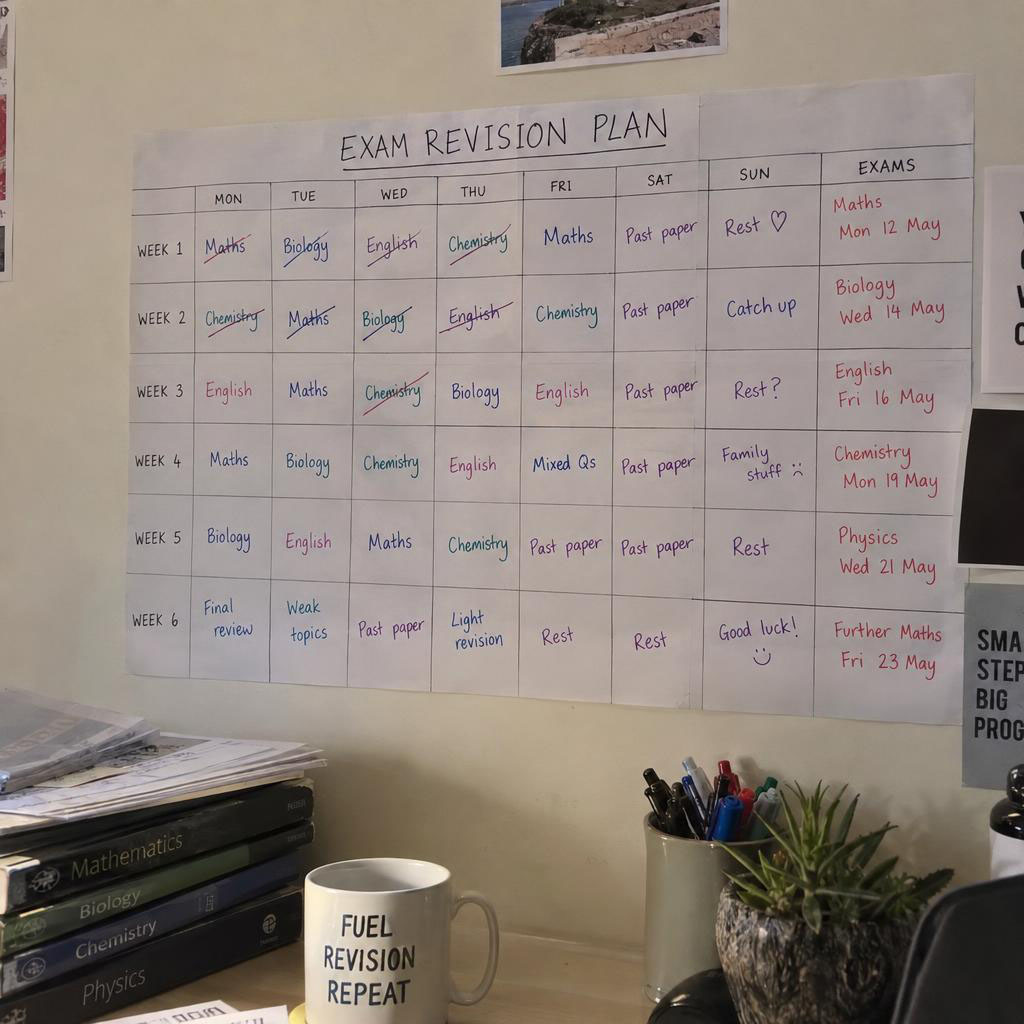
Map every topic across every subject onto a revision timetable, with enough repetition that nothing falls out of memory. Most students who underperform at IGCSE do so not because they did not understand the content, but because they ran out of time to revise it properly. Building the timetable in November of the exam year, and protecting it from drift, is the single most useful planning task you can do.
FAQs
How many hours a day should I study IGCSEs at home?
Most home-study IGCSE students do three to five hours of focused study on weekdays during normal term, increasing in the final term before exams. Quality matters more than quantity. Four hours of genuinely focused study using active methods will produce more than seven hours of unfocused re-reading with a phone within reach. Break the day into shorter blocks with proper breaks, eat properly, sleep properly, and protect weekend time at least until the exam term. Track what you actually do rather than what you intended to do, and adjust honestly when the gap is too wide.
Can I get good IGCSE grades studying entirely at home?
Yes, and many students do. Home-study students often outperform classroom peers because they can spend more time on weak areas, work at their own pace, and avoid the distractions of a noisy classroom. The honest predictor is self-management. Students who can keep a routine going on days they do not feel motivated tend to do extremely well at home. Students who struggle with self-discipline do worse than they would in a classroom. If you fall into the second category, an online school structure with live classes and accountability is usually a better fit than fully independent study.
How do I revise for IGCSE without a teacher checking my work?
Use mark schemes as your honest marker. After completing a past paper question, mark it against the official mark scheme without being generous to yourself. Where you lost marks, work out why: did you misread the question, miss a key term, structure the answer wrongly, or genuinely not know the content. Address the root cause before moving on. For essay subjects, swap practice essays with another home-study student if you can, or use a tutor for periodic feedback. Self-marking with strict honesty produces strong outcomes when applied consistently across the year.