
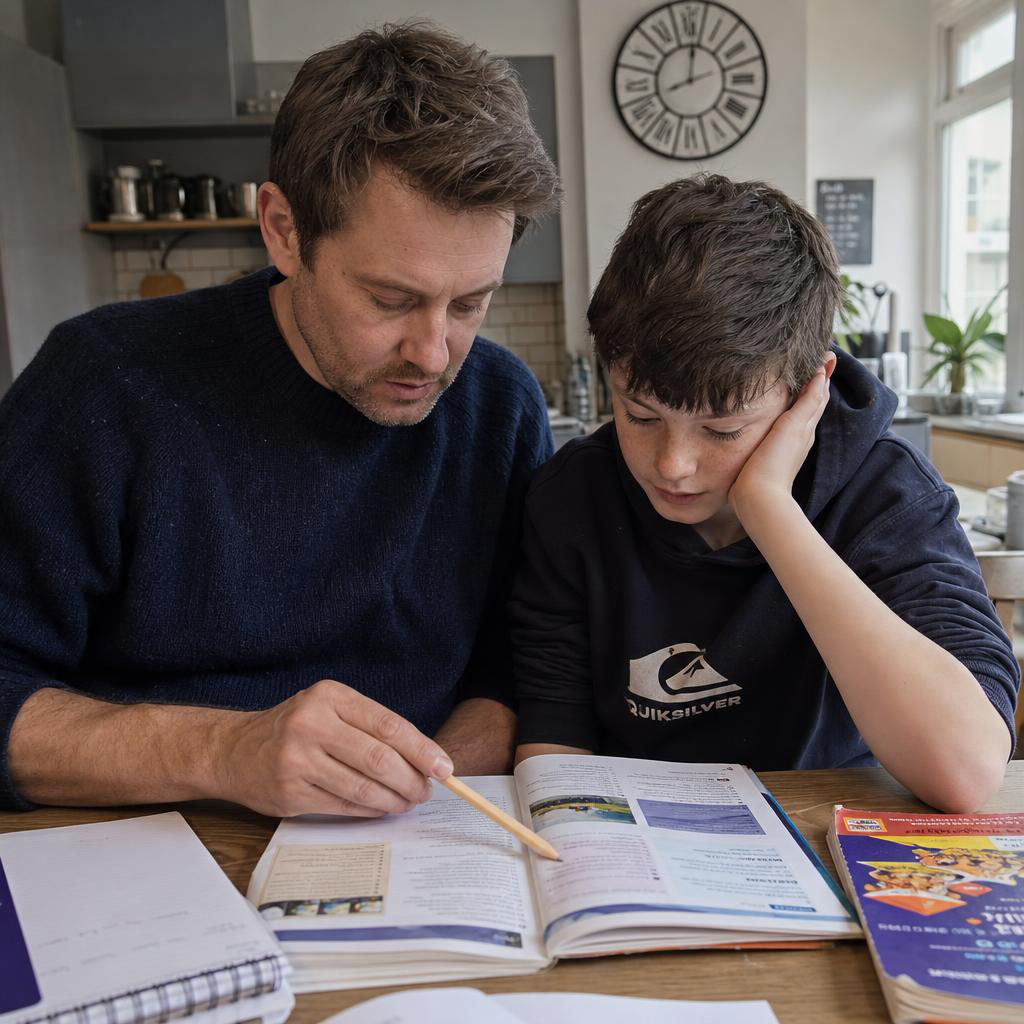
British curriculum homeschooling means teaching your child the syllabus that leads to IGCSE qualifications at 16 and A Levels at 18, the same qualifications students take at British schools worldwide, with exams sat at approved external centres rather than at a school. The British curriculum is unusually well-suited to home education for three reasons: the international versions are explicitly designed for private candidates and students outside conventional schools; the published resources for the curriculum (textbooks, past papers, mark schemes, tutoring) are extensive and easy to find; and the qualifications carry universal recognition with universities globally. Families taking this route end up with their child holding exactly the same certificates as a child who went to school every day, and the route is open to families anywhere in the world.
What looks daunting from the outside, "teaching the British curriculum at home", is one of the most established and well-supported routes in home education. The infrastructure exists; what families need to know is how to use it.
What Makes the British Curriculum Work for Home Education
Several features of the British curriculum make it a natural fit for home education.
Clear, published syllabuses. Cambridge International and Pearson Edexcel publish detailed syllabuses for every IGCSE and A Level subject, available free online. These set out exactly what students need to know, how they'll be assessed, and what each assessment objective involves. A home-educating family doesn't have to guess what to teach; the syllabus tells them.
Extensive past papers and mark schemes. Both exam boards publish past papers going back many years, along with mark schemes that show exactly what answers earn marks. This is hugely valuable for home educators because it lets you train your child against the actual assessment standard, not a proxy. By the time exams come around, students have usually seen dozens of past papers and have a clear sense of what to expect.
Private candidate routes built in. Both Cambridge International and Pearson Edexcel have long-established routes for students who didn't attend a registered school. The British Council's private candidate registration system handles entries from home-educated and online-schooled students worldwide. Registration is straightforward once you know what to do, and exam centres exist in most major cities.
A vast textbook and tutor market. Because the British curriculum is taught at thousands of schools globally, the supporting market is enormous. Endorsed textbooks for every subject, online courses, tutors, revision guides, and study apps all exist in abundance. A home-educating family has more resources available than a school could afford to buy.
Recognised qualifications. A British curriculum IGCSE or A Level certificate is the same document whether the student studied at Eton, in their living room in Dubai, or with a tutor in Buenos Aires. Universities and employers recognise the qualifications, not the school.
How British Curriculum Homeschooling Works in Practice
Most families homeschooling the British curriculum follow a fairly consistent structure across the years.
The primary years (ages 5-11) typically combine published resources, the family's own choices, and lots of reading. Some families follow Cambridge Primary, the structured curriculum Cambridge International publishes for ages 5-11, which sets clear learning objectives and is supported by published textbooks. Others use the English National Curriculum (which doesn't lead to formal exams at this age) or simply teach the broad core areas (English, maths, science, history, geography, languages) using a mix of resources. There's no formal external assessment at this age, so the curriculum can be flexible.
The middle years (ages 11-14, Key Stage 3) are typically where families start building consistent academic habits. Many families adopt Cambridge Lower Secondary or follow IGCSE-aligned textbooks at a gentler pace, preparing the ground for the more demanding IGCSE years. This is also when many families either start using an online school to handle some or all subjects, or arrange tutors for specific subjects where the parent doesn't feel confident teaching.
The IGCSE years (ages 14-16) are usually the most structured. Students typically take seven to nine IGCSE subjects, with each subject following a defined syllabus and culminating in external exams. Families register children as private candidates a few months before the relevant exam session, sit exams at a British Council office or approved centre, and receive certificates from Cambridge International or Pearson Edexcel.
The A Level years (ages 16-18) focus on three or four subjects in much greater depth. The teaching demands at A Level are substantial enough that many families who taught earlier years themselves switch to an online school or specialist tutors for the A Level subjects. Universities use A Level results (typically with a personal statement and sometimes admissions tests) to make admission decisions.
Registering for Exams as a Private Candidate
This is the question new home-educating families ask most, and the process is more manageable than it might sound.
The process starts with finding an exam centre. British Council offices in most countries accept private candidate registrations for both Cambridge International and Pearson Edexcel. Some registered Cambridge or Pearson Edexcel schools also accept external candidates, sometimes more cheaply than the British Council. Local home education networks and online forums are good places to find out which centres accept private candidates in your area.
Registration deadlines vary by session but typically fall three to four months before the exam date. For the May/June session, registration usually closes in February; for October/November, in August or September. Late registration is sometimes available at higher fees. Most centres require the candidate's full name, date of birth, the subjects and codes to be entered, and payment in advance.
Costs vary by centre and region. Cambridge International IGCSE fees through the British Council typically range from £100 to £200 per subject, with similar fees for Pearson Edexcel. The centre often charges an additional venue fee on top. A full IGCSE series of eight or nine subjects therefore costs around £1,500 to £2,500 in exam fees alone, plus any travel costs to reach the centre.
Practical exams for science subjects are the one area where private candidates need to plan carefully. Cambridge IGCSE Biology, Chemistry, and Physics each offer an "Alternative to Practical" paper that doesn't require lab access. Pearson Edexcel International GCSE sciences have similar written practical-skills components. Confirming with your chosen centre which papers they offer for private candidates is worth doing well in advance.
Common Concerns
A few practical concerns come up consistently.
"How do I teach subjects I don't understand myself?" This is the most common worry, and it has straightforward answers. You don't have to teach everything yourself. Online schools, subject tutors, video lessons, and structured curricula exist for every subject. Many parents handle some subjects directly and outsource others, particularly at A Level. The market for tutoring British curriculum subjects is enormous, and rates vary widely.
"What about practical subjects?" Science practicals are handled through written "Alternative to Practical" papers, as above. Subjects like Drama and Music can be taken with practical components at some exam centres or in their written-only forms. PE and Art usually involve coursework that can be done at home and submitted to the centre. The available options for each subject are set out in the syllabuses; reading them before committing avoids surprises later.
"Will my child be at a disadvantage compared to schooled peers?" The exam doesn't know how the student studied. The certificate doesn't say. Universities don't ask. The qualification is the qualification, and home-educated students consistently win places at competitive universities including Oxbridge.
"What about socialisation?" This is a question for families homeschooling in the UK and abroad alike. Home-educated children build social lives through home education groups, sports clubs, music and drama groups, religious communities, and shared activities with other home-educating families. The peer group is usually broader in age than at school, often considered a strength.
FAQs
How do I find out what content I need to teach for each subject?
Every Cambridge International and Pearson Edexcel subject has a published syllabus available free online. The syllabus is the definitive source: it sets out the content students need to know, the assessment objectives, the structure of the exams, and the weighting of each component. Most syllabuses are 30 to 60 pages long. The first thing any home-educating family planning to take a particular subject should do is read the relevant syllabus end to end. Past papers from previous exam sittings give a sense of how the content is actually tested, and mark schemes show what examiners reward. Together, the syllabus, past papers, and mark schemes provide enough guidance to teach any IGCSE or A Level subject confidently, even without a teaching background.
Do home-educated students need to do coursework?
This depends on the subject and exam board. Some IGCSE and A Level subjects include compulsory coursework or controlled assessment elements (English Literature historically, some Art and Design subjects, some Modern Foreign Languages). Most science, mathematics, and humanities subjects are now assessed entirely through written exams, making them straightforward for private candidates. For subjects with coursework, the exam centre will provide guidance on how home-educated candidates submit work for moderation. In some cases, choosing the alternative exam board for that subject (Cambridge vs Pearson Edexcel) avoids the coursework requirement entirely. Reading the assessment structure in the syllabus before choosing a subject lets families work this out in advance.
Can my home-educated child apply to UK universities?
Yes, on exactly the same basis as school-educated students. UCAS, the UK university admissions service, accepts applications from home-educated students through the standard process. Predicted grades can come from an online school, a tutor, or another qualified person who knows the student's work. References can come from the same sources. Universities including Oxford and Cambridge regularly admit home-educated students, and the route to medical school, law, and other competitive courses works the same way for home-educated and school-educated applicants. What matters is the qualifications and the personal statement, not where the student studied. Some universities ask additional questions about home-educated applicants in interviews, but this is a matter of curiosity rather than concern.