Hsg uk schema · HTML Copy
Cognia accreditation badge
Multi-Curriculum Online School
Pearson Edexcel · Cambridge · Cognia · NCAA Approved

Homeschooling inthe United Kingdom

Homeschooling is legal across the UK. Education is compulsory; school is not. In the 2024/2025 academic year, 175,900 children in England were recorded as electively home educated, a 15% increase from the previous year. The rules differ between England, Scotland, Wales and Northern Ireland. This guide covers the legal framework, how to start, curriculum options and costs.

6
curriculum
pathways
98%
university
acceptance
80,000+
students
educated
20
years
established
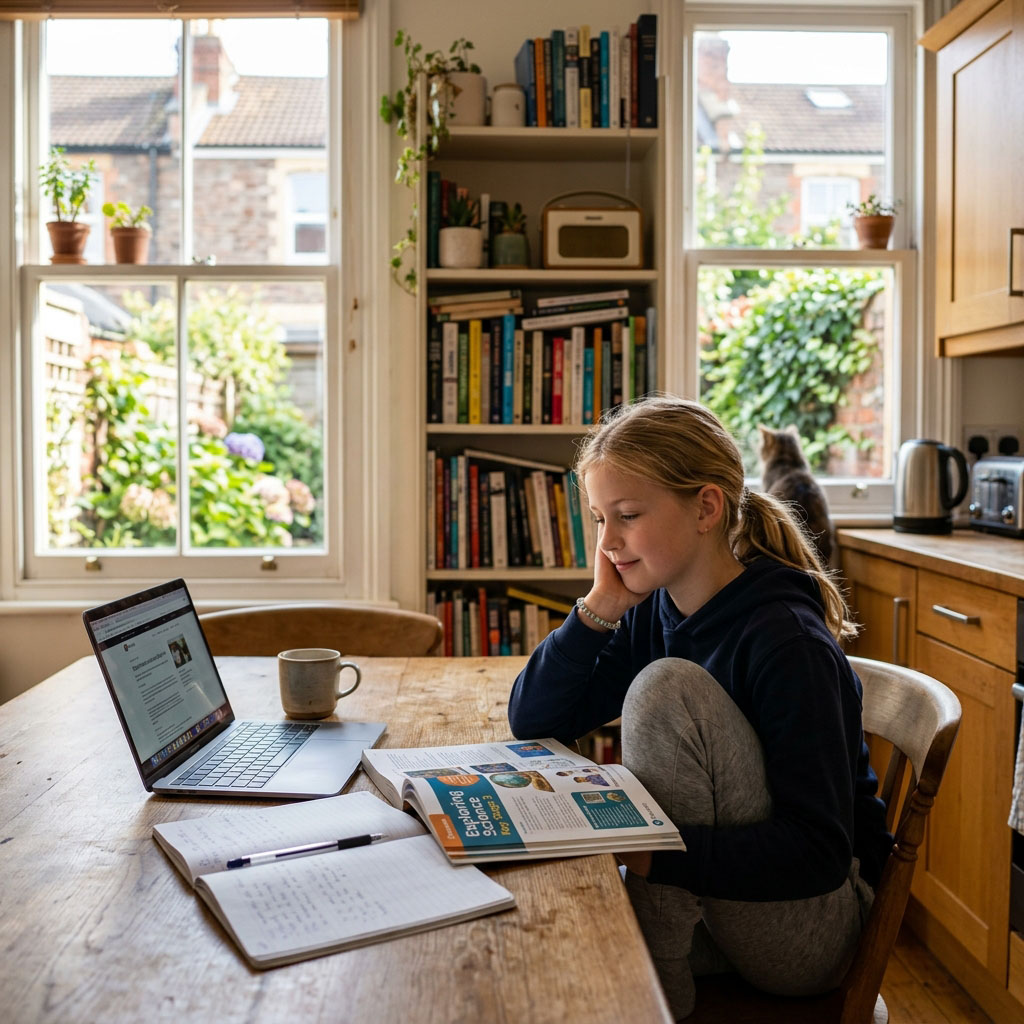
Child learning at home in the United Kingdom
Legal status

Is homeschooling legal in the UK?

Yes. Section 7 of the Education Act 1996 places the duty on parents to ensure their child receives "efficient full-time education suitable to his age, ability and aptitude, and to any special educational needs he may have." That education can happen at school or "otherwise." The word "otherwise" is what gives UK parents the legal right to home educate.

You do not need to follow the National Curriculum. You do not need teaching qualifications. You do not need to replicate a school timetable. The law requires a suitable education, not a school-shaped one.

The rules differ across the four UK nations. Here is what applies in each.

England

No registration is required if your child has never attended school. If your child is currently enrolled, you must write to the headteacher requesting that the child's name be removed from the school roll. The school must comply (unless the child is subject to a School Attendance Order). Your local authority may make informal enquiries to satisfy itself that your child is receiving a suitable education, but it has no automatic right to enter your home or see your child.

Scotland

If your child has attended a local authority school, you need consent from the local authority to withdraw them. This is the key difference from England. If the child has never attended a public school, or attended only an independent school, no consent is needed. The Education (Scotland) Act 1980 governs this. Home education in Scotland is overseen by the local authority, which may request evidence that education is being provided.

Wales

The framework mirrors England. You write to the headteacher to deregister. Welsh local authorities maintain a database of home-educated children and will make contact as a standard part of the process. The Welsh government emphasises "efficient and full-time" education, but this does not mean replicating school hours. It means consistent education across a broad range of experiences appropriate to the child's development.

Northern Ireland

Parents must ensure their child receives "efficient full-time education" under the Education and Libraries (Northern Ireland) Order 1986. If your child is enrolled in a school, you write to the principal to deregister. The Education Authority (EA) may ask for information about your educational provision. You can respond with a descriptive report rather than formal lesson plans.

Children's Wellbeing and Schools Bill. This Bill, progressing through Parliament in 2025/2026, proposes a mandatory register of all home-educated children in England. The Lords completed Report Stage in January 2026. If enacted, it would require families to register with their local authority and would give councils the power to request a meeting within 15 days. It would not change the fundamental right to home educate, and it would not give authorities new powers over curriculum content. Secondary legislation and guidance would need to be drafted and consulted on before any requirements take effect. Check Parliament's tracker for the latest status.

Getting started

How to start homeschooling in the UK

The process depends on whether your child is currently enrolled in a school.

If your child is in school

Write to the headteacher (or principal, in Northern Ireland) stating your intention to withdraw your child for home education. In England and Wales, the school must remove the child from its roll. In Scotland, you need local authority consent first. Keep a copy of your letter. The school will notify the local authority, which may then contact you.

If your child has never attended school

In England, you are not legally required to inform anyone. You can simply begin educating your child at home. In practice, some families choose to notify their local authority voluntarily. In Scotland, the same applies if the child has never attended a public school.

Choose a curriculum

You are not required to follow the National Curriculum. Most home-educating families in the UK choose from International GCSEs and A-Levels (Cambridge* or Pearson Edexcel), the National Curriculum delivered through a tutor or resource provider, or a bespoke approach mixing resources around the child's interests. If you enrol with an online school like CambriLearn, the school provides the curriculum, teaching, materials and assessment.

Set up for learning

Your child needs a quiet workspace and a reliable internet connection if using an online provider. There is no legal requirement for a dedicated room or specialised equipment. If you are using an online school, the school provides the timetable, lesson materials and teacher support. If you are teaching independently, you will need to source textbooks and plan your own assessment schedule.

Local authority visits. If your local authority contacts you, you can respond in writing with a description of your educational provision. You are not required to allow a home visit, provide lesson plans, or show your child's work. Many families choose to engage cooperatively, but the legal position in England and Wales is clear: the burden is on the local authority to show evidence that a suitable education is not being provided, not on you to prove that it is.

Curriculum options

Which curricula can homeschooled students follow in the UK?

UK families can choose any curriculum. You are not restricted to the National Curriculum. The qualification your child earns determines which universities and employers will recognise it.

CurriculumQualificationExam BodyUK University AdmissionInternational RecognitionVia CambriLearn
Cambridge Int.*Int. GCSE, AS, A-LevelCambridge AssessmentAccepted by all UK universities via UCAS160+ countriesYes, private candidate exams
Pearson EdexcelInt. GCSE, Int. A-LevelPearsonAccepted by all UK universities via UCAS80+ countriesYes, accredited centre
National CurriculumGCSE, A-LevelAQA, OCR, Pearson, EduqasStandard UK routeVariesNo
US K-12US High School DiplomaCogniaVia UCAS (with additional evidence)US, NCAA approvedYes, Cognia accredited
CAPSNSC matricSACAIVia UCAS equivalencySouth Africa, select internationalYes, billed in ZAR

Sitting exams as a private candidate. Home-educated students in the UK sit GCSEs, International GCSEs, and A-Levels as private candidates at registered exam centres. You contact the exam centre directly to register, typically by October for summer exams. International GCSE (Cambridge and Edexcel) syllabuses are designed for external candidates and do not require coursework, which makes them a practical choice for home educators. National Curriculum GCSEs from AQA or OCR sometimes include compulsory coursework or practicals, which can be harder to arrange externally.

CambriLearn prepares students for Cambridge* examinations as private candidates and holds accredited centre status for Pearson Edexcel. For a detailed comparison of how each pathway leads to UK university admission via UCAS, see the A-Levels page.

What it costs

How much does homeschooling cost in the UK?

Costs range from near-zero (parent-led, using free resources and library books) to several thousand pounds per year for a full online school programme with live teaching. The main variables are the curriculum, the level of teacher support, and exam fees.

UK state school

Free tuition. Indirect costs (uniform, trips, lunches, transport) average £800-£1,500/yr depending on region.

UK private school

£15,000-£45,000+/yr for day school. Boarding schools exceed £50,000/yr. Plus uniforms, trips and extracurriculars.

CambriLearn online school

International curricula priced in USD. Three package tiers. No transport, uniform or facilities costs. View pricing.

Exam fees are separate. Home-educated students sit exams as private candidates at registered centres. International GCSE and A-Level exam fees vary by centre and subject count but typically run £100-£300 per subject, per sitting. You register directly with the exam centre, usually by October for summer exams.

Full fee schedules for every CambriLearn curriculum and grade level are on the pricing page.

After A-Levels

Can home-educated students go to university in the UK?

Yes. Home-educated students apply through UCAS on the same basis as school-leavers. Universities assess the qualification, not the setting in which it was studied. Cambridge A-Levels, Pearson Edexcel International A-Levels and standard A-Levels all carry the same UCAS tariff points.

UCAS applications for home-educated students

You apply through UCAS as an individual (without a school or centre reference). You write your own personal statement. You can ask a tutor, employer, or other suitable adult to provide a reference. Some universities request an interview or portfolio from home-educated applicants, particularly for competitive courses.

Which qualifications do UK universities accept?

All UK universities accept A-Levels (whether Cambridge, Edexcel or domestic exam boards) through UCAS. International GCSEs are treated equivalently to domestic GCSEs by every Russell Group university. US high school diplomas are accepted by UK universities, though applicants may need to demonstrate equivalent subject depth through AP or SAT scores.

CambriLearn graduates

CambriLearn graduates hold a 98% university acceptance rate across UK, South African and international institutions. Graduates have been accepted at Oxford, Cambridge, UCL, Imperial, Edinburgh, Warwick, Durham, and other leading UK universities, alongside institutions in the US, Europe and South Africa. Over $25 million in scholarships has been earned by CambriLearn students to date.

Common questions about homeschooling in the UK

Do I need permission to homeschool in the UK?
In England, Wales and Northern Ireland, no. You do not need permission from anyone to educate your child at home. If your child is currently enrolled in a school, you must write to the headteacher to deregister them. In Scotland, you need consent from the local authority if the child has been attending a local authority school.
Do I have to follow the National Curriculum?
No. Home-educating families in the UK can follow any curriculum they choose, or no formal curriculum at all. The only legal requirement is that the education is "efficient, full-time and suitable" to the child's age, ability and aptitude. Many families choose International GCSEs and A-Levels through Cambridge* or Pearson Edexcel because the syllabuses are designed for external candidates and do not require coursework.
Do I need teaching qualifications?
No. UK law does not require parents to hold any teaching qualification to home educate. If you want qualified teachers to deliver the instruction, you can enrol your child with an online school like CambriLearn, where degree-qualified teachers handle lessons, marking and assessment.
Can my home-educated child sit GCSEs and A-Levels?
Yes. Home-educated students sit exams as private candidates at registered exam centres. International GCSEs (Cambridge and Pearson Edexcel) are the most common choice because they are assessed entirely by exam, with no compulsory coursework. You register directly with an exam centre, typically by October for summer sittings. CambriLearn prepares students for these exams and holds accredited centre status for Pearson Edexcel.
Can the local authority inspect my home?
In England, your local authority has no automatic right to enter your home, see your child, or inspect your educational provision. It may make informal enquiries to satisfy itself that your child is receiving a suitable education. You can respond in writing. If the authority believes a suitable education is not being provided, it can issue a School Attendance Order, which you can challenge. The legal burden is on the authority to demonstrate that education is inadequate, not on you to prove it is adequate.
What is elective home education?
Elective home education (EHE) is the official UK term for a parent's decision to educate their child outside the school system. "Elective" distinguishes it from children who are out of school for other reasons (exclusion, illness, school refusal). The term appears in local authority policies and government guidance. In practice, it covers everything from structured curriculum-based learning to informal, child-led education.
What is the Children's Wellbeing and Schools Bill?
A Bill progressing through Parliament (Lords Report Stage completed January 2026) that would create a mandatory register of home-educated children in England. If enacted, families would need to register with their local authority. It would not change the right to home educate, and it would not give authorities new powers over curriculum. Secondary legislation and regulations would need to be drafted before any requirements take effect. The Bill has not yet received Royal Assent.
How do home-educated children socialise?
Through sport, music, art, Scouts, Guides, community groups, home education co-ops, and online communities. The UK has a well-established network of local home education groups that organise regular meetups, field trips and shared activities. CambriLearn runs CambriCommunity, which connects students through group activities, clubs and collaborative projects. Many families find that removing the social pressures of school allows children to build stronger, more genuine friendships through shared interests.
Can I homeschool part-time (flexi-schooling)?
Flexi-schooling is an arrangement where a child is registered at a school but attends part-time, with the remaining education provided at home. Schools are not required to agree to this, but some do. The child remains on the school roll and subject to the school's curriculum for the days they attend. This is different from full home education, where the child is removed from the school roll entirely.
Which curriculum should I choose for my child in the UK?
Cambridge* International GCSEs and A-Levels and Pearson Edexcel International GCSEs and A-Levels are the most popular choices for UK home educators because the exams are taken externally with no coursework requirement. Both are accepted by all UK universities through UCAS. The US K-12 pathway suits families targeting American universities or NCAA athletic scholarships. CambriLearn offers all three pathways. A consultant can help you decide based on your child's age, goals and university plans.

Education that goes
where you go.
Born Unstoppable.

Six accredited curricula. 100+ countries. Live specialist teachers. 20 years of online education. 80,000+ students educated worldwide.

Free consultation · No obligation · Response within 24 hours

*CambriLearn is not a registered Cambridge school and is not affiliated with or endorsed by Cambridge University or Cambridge University Press. "International British Curriculum" refers to the curriculum framework delivered by CambriLearn, which prepares students to write examinations administered by Cambridge Assessment International Education at independently registered examination centres as private candidates. CambriLearn is accredited by Cognia and is a Pearson Edexcel-accredited centre. Legal information on this page reflects UK law as of early 2026. The Children's Wellbeing and Schools Bill had not received Royal Assent at the time of publication. Verify current requirements with your local authority or check gov.uk before making decisions.