
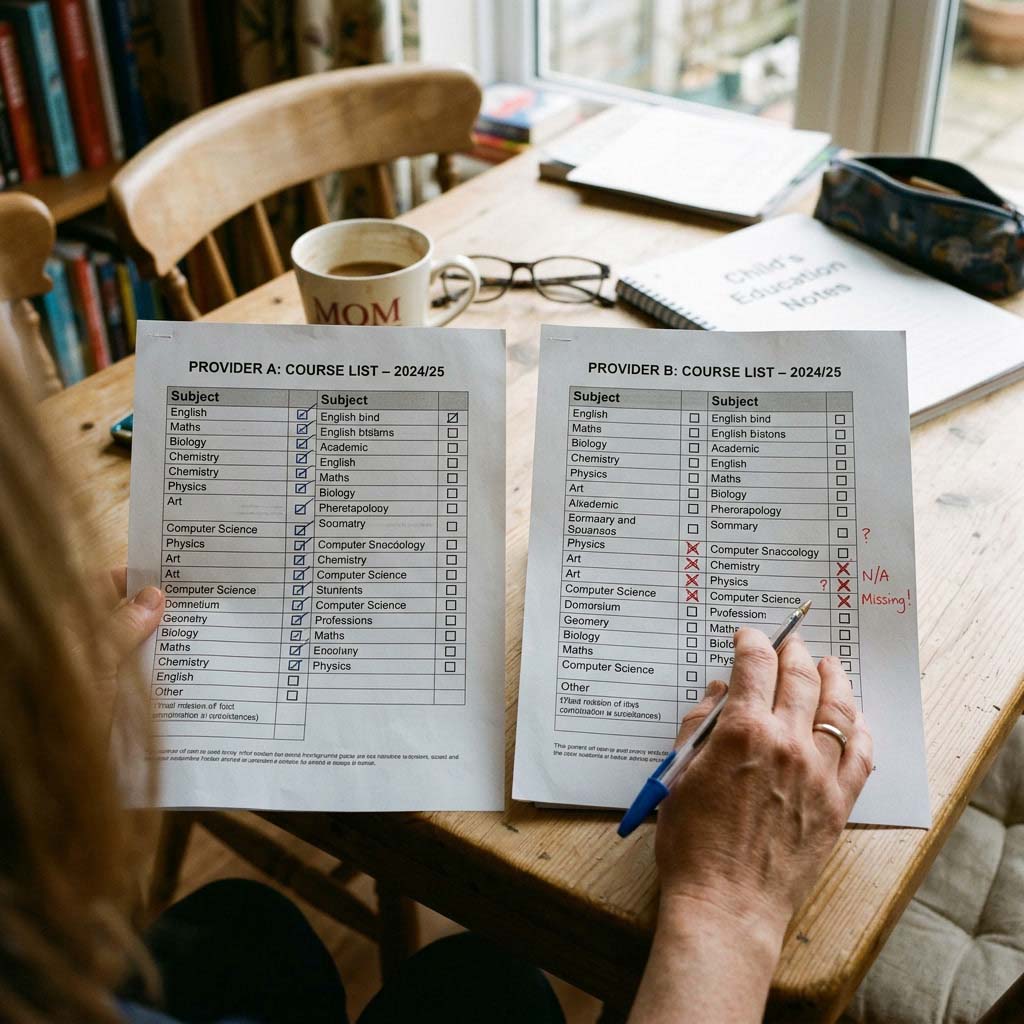
The market for online IGCSE schools has grown considerably over the past few years, with several credible providers operating internationally. The right one depends on what your family needs: structured live teaching or flexible self-paced study, Cambridge International or Pearson Edexcel exam boards, time-zone fit, subject availability, and total cost. There's no universal best provider, but there are clear ways to narrow the shortlist quickly to the schools that genuinely fit your situation.
This guide covers the IGCSE market, what to look for in an online provider, and how to compare options meaningfully rather than relying on marketing claims.
What IGCSE Actually Means
IGCSE stands for International General Certificate of Secondary Education. The qualification was developed by Cambridge International (then UCLES) in 1988 specifically for international students. Pearson Edexcel offers its own version, the International GCSE, which is broadly equivalent but with different specifications and a January exam session option. AQA also offers some international qualifications through its Oxford AQA partnership.
A key distinction families often miss: Cambridge IGCSEs and Pearson Edexcel International GCSEs are not regulated by Ofqual, the UK qualifications regulator. UK domestic GCSEs are Ofqual-regulated. International qualifications are regulated by their respective exam boards. The Ofqual Register of Regulated Qualifications confirms which qualifications fall under UK regulation. This distinction matters for some specific UK pathways (certain regulated professions, certain UK university entry routes for non-traditional applicants) but doesn't affect general university recognition. IGCSEs remain widely accepted by universities globally, including UK universities, as equivalent to GCSEs for entry purposes.
For most international families, the Cambridge IGCSE or Pearson Edexcel International GCSE is the natural fit. Both are widely recognised, both work as preparation for A Levels or other sixth form qualifications, and both are taken at registered exam centres worldwide.
The Three Main Teaching Models
Online IGCSE providers fall into the same three broad categories as A Level providers, with different trade-offs for younger students.
Live-class online schools run scheduled lessons with subject teachers, follow a school timetable, and maintain peer cohorts. This model suits students who need structured teaching, benefit from peer interaction, and learn well through real-time discussion. Examples include Kings InterHigh and Cambridge Home School Online. Fees typically run higher (often GBP 5,000-10,000+ per year for IGCSE-stage). Time zones matter: live classes happen at fixed times, usually UK time.
Hybrid online schools combine live classes with recorded lessons and structured self-paced study. The student follows a timetable but with flexibility around recorded content. The International British Curriculum delivered through hybrid models often suits internationally based families well, since live sessions can be supplemented with on-demand content across time zones.
Distance learning providers supply course materials, tutor support, and marked assignments without scheduled lessons. Examples include Wolsey Hall Oxford and Oxford Home Schooling. This model suits genuinely independent learners. For younger IGCSE students (typically ages 14-16), the structure of live or hybrid teaching often matters more than at A Level, where independent study habits are usually more developed.
For most families with students at IGCSE age, hybrid or live-class models tend to fit better than pure distance learning, since most 14-16 year olds benefit from some scheduled teaching rhythm.
What to Compare Across Providers
Once you've narrowed to a teaching model, comparison across specific providers becomes meaningful.
- Accreditation. Look for recognition from credible bodies. UK independent online schools may hold Department for Education Online Education Accreditation Scheme accreditation (inspected by Ofsted). International recognition often comes through Cognia accreditation, Pearson Edexcel approved-centre status, or membership of associations like the Council of British International Schools (COBIS).
- Exam board choice. Cambridge IGCSEs are the most internationally recognised. Pearson Edexcel International GCSEs offer a January session that helps with retakes or staggered schedules. Some providers specialise in one; others offer both.
- Subject range. Larger online schools typically offer 15-25 IGCSE subjects. Smaller providers may offer 8-12. Check the specific subjects your child wants, particularly second languages, art, drama, and music, which often have narrower coverage.
- Class size. For live-class providers, smaller classes (typically 8-15 students) allow more teacher attention. Larger classes (20+) can still work well with strong teachers but reduce individual contact time.
- Teacher qualifications. Subject specialists with current or recent teaching experience produce better outcomes than generalist tutors. Ask specifically about teacher backgrounds.
- Pastoral support. IGCSE-age students benefit from pastoral support, particularly around exam anxiety, motivation, and adolescent challenges. Online schools vary considerably in what they offer.
- Mock exams. Structured mock exam programmes with proper marking and feedback help students prepare effectively. Confirm what's included.
- Total cost. Tuition, exam fees, textbooks, additional resources, and any optional services all add up. Get an annual total for the specific number of subjects you're planning.
Curriculum Considerations at IGCSE Age
IGCSEs are typically studied in Years 10-11 (ages 14-16), with most students taking 6-10 subjects over two years. Subject choice at this stage feeds into A Level options and ultimately university course access, so the decision matters.
Most students take English (Language and/or Literature), Mathematics, at least one science (or combined sciences), and a humanities subject. Beyond this core, choice depends on interests and likely sixth-form direction. Students considering competitive STEM degrees often take separate sciences (Biology, Chemistry, Physics) rather than combined sciences. Students considering humanities or languages degrees often take additional languages.
Check that the provider you're considering offers the specific subjects your child wants. A provider that doesn't offer Additional Mathematics, Further Mathematics, or specific second languages may not work for a student aiming for certain A Level combinations.
Comparing GCSE-Level Online Providers
The major online IGCSE providers operate at different ends of the market.
Premium live-class providers (Kings InterHigh, Cambridge Home School Online) typically charge GBP 5,000-10,000+ per year, with class-based scheduled teaching, full peer cohort, and intensive support. Suits families wanting school-like structure delivered online.
Hybrid providers (CambriLearn, Minerva's Virtual Academy, and others) typically charge mid-market fees, deliver a combination of live and recorded content, and often work well for international families needing time-zone flexibility. Suits families wanting structure with flexibility.
Distance learning providers (Wolsey Hall, Oxford Home Schooling, Open Study College) typically price per subject, with lower headline costs but per-subject totals that add up for a full IGCSE programme. Suits genuinely independent older IGCSE students, though many 14-16 year olds benefit from more structured teaching than distance learning provides.
Within each category, providers vary considerably on teacher quality, accreditation, mock exam programmes, pastoral support, and exam centre arrangements. The marketing language tends to overlap; the actual experience varies.
Questions Worth Asking Before Enrolling
A practical short list:
- What's the actual class size for live lessons by subject?
- Are teachers subject specialists with recent teaching experience?
- How are mock exams structured, marked, and fed back to students?
- What pastoral support is available, and how is it delivered online?
- How are exam centre arrangements handled, particularly for international students?
- What's the policy on changing or adding subjects mid-year?
- Are exam fees included in tuition, or charged separately?
- Can we trial the platform or speak with current families?
A short trial or sample lesson, where available, gives a sharper signal of fit than reviews or marketing materials.
Family Situations and Best-Fit Providers
Different family situations point toward different providers.
- Students moving from a traditional school to online. Often benefit from structured live teaching that replicates the school experience. Live-class providers typically suit best at the transition.
- Internationally based families. Often need time-zone flexibility, which hybrid models with on-demand content typically deliver better than strict live-class schedules. Provider experience with exam centre arrangements in your country matters.
- Students who struggled with school environment. May benefit from smaller class sizes and more individual attention. Hybrid providers with small live classes often suit well.
- High-performing students. May benefit from subject depth, challenging material, and ambitious peers. Live-class schools with high-performing cohorts typically deliver well.
- Students with significant non-school commitments. Sport, performing arts, or other major commitments often require timetable flexibility. Hybrid models work better than strict live-class schedules.
- Cost-conscious families. Distance learning provides the lowest per-subject cost but suits only genuinely independent students. Hybrid models often offer better total value than distance learning once added support is considered.
FAQs
Are Cambridge IGCSEs and Pearson Edexcel International GCSEs interchangeable?
They're broadly equivalent but not identical. Both are recognised by universities globally as equivalent to UK GCSEs for entry purposes. Cambridge IGCSEs are the more widely available internationally and the more established brand. Pearson Edexcel International GCSEs offer a January exam session (Cambridge doesn't), which helps for retakes or staggered exam schedules, and the specifications differ in specific subjects. For most families, the choice comes down to which exam board the chosen provider offers and which exam centres are accessible. Mixing boards across subjects is possible, though it adds complexity. Ask the provider which boards they support and how exam centre logistics work for each.
Do online IGCSE schools provide enough support for students who struggled with traditional school?
It depends on the provider and the specific reasons the student struggled. A student who struggled with social environment or large class sizes may thrive in a smaller online setting with more individual teacher attention. A student who struggled with self-motivation or executive function may find unstructured online learning even harder than traditional school. The key is matching the model to the student's actual challenges, not assuming online is automatically better or worse. Strong pastoral support, regular teacher contact, and clear structure matter more than the headline of being online. Ask specifically how the provider supports students returning to study after difficult experiences.
How important is the difference between Ofqual-regulated GCSEs and international IGCSEs?
For most international families, the practical difference is small. IGCSEs are accepted by UK universities as equivalent to GCSEs, and universities globally accept them for entry purposes. The Ofqual regulation question becomes more relevant for specific UK pathways: some regulated professions (certain healthcare and teaching qualifications) specifically require Ofqual-regulated GCSEs, and some UK universities apply slightly different equivalence assessments for non-Ofqual qualifications when used for non-traditional entry. For families studying online primarily for international university destinations, the question rarely matters. For families with a specific UK pathway in mind that may require Ofqual-regulated qualifications, it's worth confirming with the target institution before committing to an IGCSE rather than a UK GCSE pathway.