
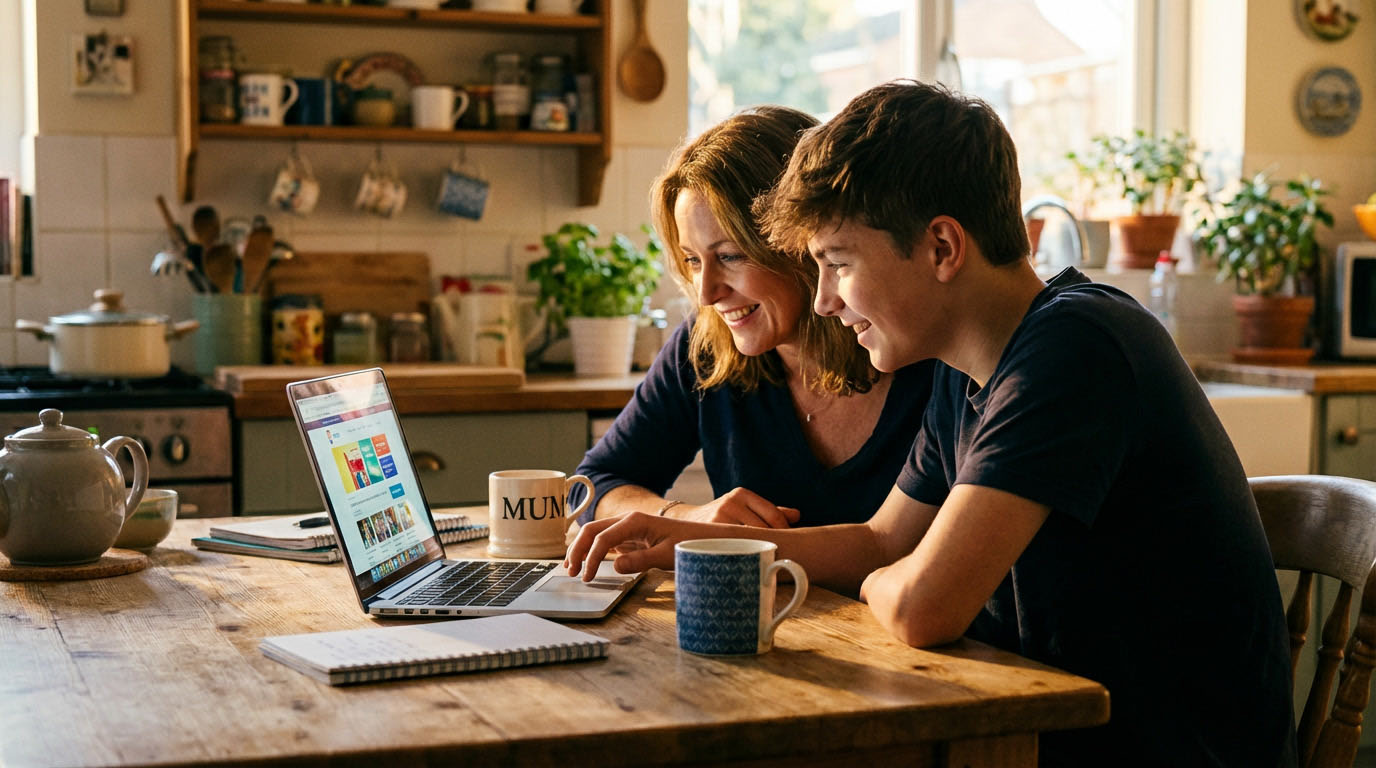
Something is shifting in British education, and it's worth paying attention to.
Between 2021 and 2024, the number of children being home educated in England rose by roughly 40%. The reasons vary: mental health pressures, bullying, children with additional needs who weren't getting the support they needed, families who travel, kids whose talents don't fit neatly into a classroom timetable. Whatever the trigger, more UK parents than ever are looking at online school for UK families and trying to work out whether it could genuinely work for their child.
This guide answers the questions that actually matter. Not the marketing fluff you'll find on most school websites, but the practical, sometimes awkward stuff: Is it legal? Will my child get proper qualifications? What does it cost? And will they end up socially isolated?
Let's get into it.
Is online schooling legal in the UK?
Yes. Completely.
In England and Wales, parents have a legal right to educate their children outside of the school system. The Education Act 1996 requires that children receive "efficient full-time education suitable to their age, ability and aptitude" — but it does not require that education to happen in a school building.
You don't need the local authority's permission. You don't need to follow the national curriculum. You do need to provide a suitable education, and your local council can make informal enquiries to check that you're doing so, but they cannot insist on visiting your home or seeing your child's work (though cooperating tends to make life easier for everyone).
Scotland and Northern Ireland have slightly different rules — Scotland requires notification to your local authority, and Northern Ireland requires written consent from the Education Authority — but in all four nations, educating your child at home or through an online school is a lawful option.
The part that catches some parents off guard: once you withdraw your child from a state school, the school must remove them from the roll within a few days. There's no trial period. You're making a decision, not requesting a leave of absence.
Which qualifications can online school students actually get?
This is the question that matters more than any other, and it's where the differences between providers become obvious.
Online school students in the UK can sit internationally recognised examinations as private candidates. The two main pathways for British-style qualifications are Pearson Edexcel and Cambridge Assessment International Education.
International GCSEs and A Levels through Pearson Edexcel
Pearson Edexcel International GCSEs and International A Levels are accepted by UK universities, including for UCAS applications. CambriLearn accredited by Pearson Edexcel, which means students can sit their exams through a structured, supported process rather than navigating private candidate registration on their own.
This matters more than many parents realise. Being accredited means exam logistics are handled, results are processed directly, and students aren't left scrambling to find an exam centre that will accept them.
International GCSEs and A Levels through Cambridge Assessment International Education
Cambridge qualifications are well established internationally and recognised by UK universities. CambriLearn's British curriculum prepares students for Cambridge Assessment International Education examinations, which students sit at registered examination centres as private candidates.
It's worth noting: CambriLearn is not a registered Cambridge school and is not affiliated with or endorsed by Cambridge University or Cambridge Assessment International Education. Students register as private candidates at approved examination centres, where Cambridge sets and marks the exams and issues results directly.
Both Edexcel and Cambridge qualifications carry weight with UK universities. The practical difference comes down to exam access and support — and that's where an accredited provider has a real advantage.
UCAS and university entry
International GCSEs and A Levels (from both Edexcel and Cambridge) are listed on the UCAS tariff and accepted by Russell Group universities. Students apply through UCAS in exactly the same way as any other applicant. Their predicted grades come from their school — in this case, their online school — and universities assess applications on results, personal statements, and references. They don't disadvantage online school students.
What does online school in the UK actually cost?
Pricing varies enormously across providers, and most aren't transparent about it until you book a consultation call. As a rough guide, full-time online schooling in the UK typically ranges from £2,000 to £8,000 per year, depending on the curriculum, grade level, and level of support included.
Some things to watch for when comparing costs: whether exam fees are included or charged separately, whether textbooks and materials are part of the package, whether live lessons or tutor access costs extra, and whether you're locked into an annual contract or can pay monthly.
At CambriLearn, pricing is per subject and depends on the curriculum, grade level, and package tier. There's no registration fee. Families can choose between Standard and Premium support packages — and subjects can be mixed across packages if your child needs more support in certain areas. British curriculum exam fees for external examinations are paid separately to the examination centre.
What a typical day looks like
This is the bit that's hardest to picture if you've only ever known traditional school.
Online schooling doesn't mean your child sits in front of a screen from 8am to 3pm. Most providers use asynchronous content — pre-recorded video lessons that students can watch, pause, rewind, and rewatch whenever it suits them. Some providers supplement this with live sessions for group discussion, Q&A, or tutorial support.
A realistic school day might look like three to four hours of focused academic work for primary students, and four to six hours for secondary students. That's less than a traditional school day, but without assemblies, registration, transitions between classrooms, and the general waiting around that fills a conventional timetable, it's often more productive.
The CambriLearn timetable structure gives families a framework to work from, but one of the genuine advantages of online schooling is that your child can study when they learn best. Some kids are sharp at 6am. Others don't hit their stride until the afternoon. Traditional schools can't accommodate that. Online schools can.
A word of caution, though: flexibility without structure becomes chaos. The families that do well with online schooling are the ones that build a consistent routine from day one. It doesn't have to mirror school hours, but it does have to exist.
"But what about socialisation?"
Every parent asks this. It would be strange if you didn't.
The honest answer: socialisation requires effort regardless of how your child is educated. Plenty of children in traditional schools are lonely, excluded, or anxious. Plenty of home-educated children have rich social lives. The setting matters less than whether parents actively create opportunities for their child to interact with peers, build friendships, and develop social skills.
Online schools that take this seriously provide community platforms, group projects, live collaborative sessions, and connections to local activities. CambriLearn runs CambriCommunity, a platform where students connect with peers, join interest groups, and access social opportunities beyond their academic work.
For families who travel, live rurally, or have children who were bullied or struggling in mainstream settings, online school often improves social wellbeing rather than diminishing it. Removing the daily source of stress gives kids space to rebuild confidence and engage with peers on their own terms.
That said, if your child is naturally social and thriving at their current school, online education probably isn't the answer to a problem you don't have.
How to choose an online school in the UK
Not all online schools are built the same. Some are little more than a content library with a login page. Others provide structured, teacher-supported programmes with proper accreditation and pastoral care.
When you're comparing providers, these are the things worth scrutinising:
Accreditation and exam access. Can students sit recognised examinations through the school, or will you need to organise exam registration and find an examination centre independently? Accredited providers handle this for you. Non-accredited ones leave it to parents.
Curriculum breadth. Some providers offer only one curriculum pathway. Others, like CambriLearn, offer multiple, including British International, CAPS, Pearson Edexcel, and more. That matters if your family might relocate or if your child's needs change.
Teacher access. Is there actual teacher support, or is the "school" just pre-recorded videos with no human interaction? Weekly live lessons, tutor support hours, and responsive marking all differentiate real schools from content platforms.
Track record. How long has the school been operating? How many students have they served? CambriLearn has been doing this for 20 years, with over 80,000 students across more than 100 countries. That kind of experience shows up in the quality of the content, the exam support, and the institutional knowledge of how to handle edge cases. Because in education, there are always edge cases.
Pastoral care and community. What happens if your child is struggling? Is there someone to talk to, or does the support disappear once you've paid?
Who online school works well for
Online schooling in the UK isn't a universal solution, and any provider that tells you otherwise isn't being straight with you. It works exceptionally well for certain situations:
Families who travel or live abroad but want their child to follow a British curriculum. Children who are competing at high levels in sport, dance, music, or other disciplines that require flexible schedules. Students who were bullied, anxious, or simply unhappy in mainstream settings and need a fresh start. Kids with additional learning needs who benefit from self-paced study and the ability to revisit content. Bright students who are bored and understimulated in a conventional classroom. Families who've relocated to the UK from overseas and want curriculum continuity.
It works less well for children who need constant external motivation to engage with academic work, families where no parent or carer is available to provide any daytime oversight (particularly for younger students), and situations where the child's main reason for wanting to leave school is to avoid doing any work at all.
Frequently asked questions
Can my child do online school in the UK?
Yes. UK law allows parents to educate their children outside of the traditional school system. Online schooling through a structured provider like CambriLearn's online school for UK students is a fully legal option in England, Wales, Scotland, and Northern Ireland, though the notification requirements differ slightly between nations.
How much does online school cost in the UK?
Full-time online schooling typically costs between £2,000 and £8,000 per year, depending on the provider, curriculum, and level of support. Some providers charge per subject, which gives families more control over total costs. Exam fees may or may not be included.
Do online school students get GCSEs?
Online school students can sit International GCSEs through Pearson Edexcel or Cambridge Assessment International Education. These are internationally recognised qualifications accepted by UK universities for UCAS applications. They're not identical to domestic GCSEs set by AQA or OCR, but they carry equivalent weight for university admissions.
Will universities accept qualifications from an online school?
Yes. International GCSEs and A Levels are listed on the UCAS tariff and accepted by Russell Group universities. Students apply through UCAS in the normal way. Universities assess applications on grades, personal statements, and references — not on where the student physically sat while learning.
Is online school right for my child?
That depends on your child, your family's circumstances, and what's not working right now. If your child is struggling, unhappy, or held back by the rigidity of traditional school, online education is worth exploring seriously. The best first step is a conversation with a provider who'll be honest about whether it's a good fit. Book a free consultation to discuss your child's specific situation.