
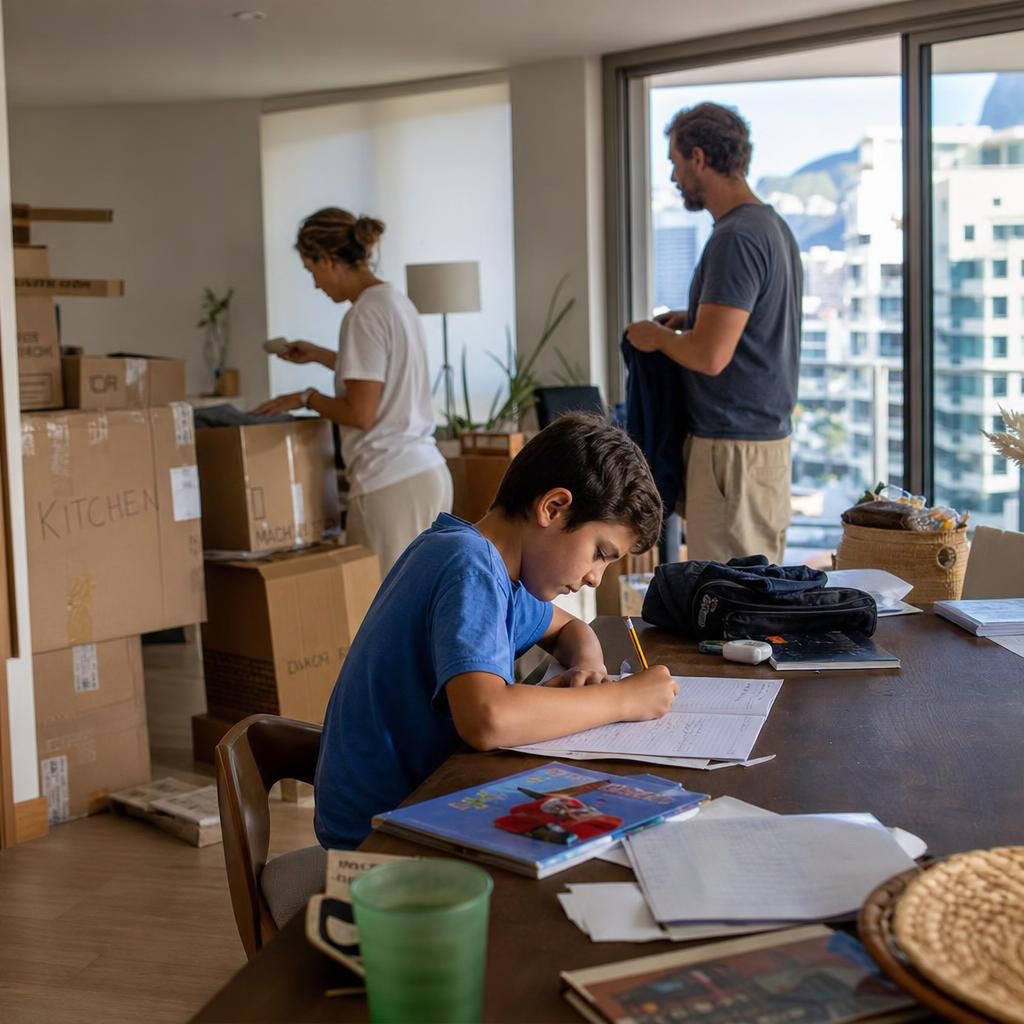
An online school for UK expat families delivers the British curriculum to children remotely, with live lessons from qualified teachers, structured progression through Key Stage 3, IGCSE, and A Level qualifications, and exam entry through approved external centres in the country where the family lives. The model exists precisely because the traditional alternatives often don't fit expat life: British international schools cost more than many families can sustain across multiple postings, local schools deliver a different curriculum, and home education works for some families but not all. An online school provides educational continuity through relocations, accreditation that parents can verify, and the same qualifications a child would earn at any British school. For families in diplomatic, military, energy sector, international business, or freelance roles where moves happen every few years, the online school is often the only option that doesn't require the child to change schools at the same time the family changes country.
The decision parents face isn't usually whether to consider an online school. It's which online school to choose, and how to be confident in the choice when the family is hundreds or thousands of miles from the provider.
Why Online Schools Suit UK Expat Families
Several features of expat life align with what online schools deliver.
Continuity across postings. A child who enrols in an online school in Year 7 can stay at the same school through Year 13, regardless of how many countries the family lives in during those years. For families who have already moved a child through multiple schools, this single feature is often decisive.
No relocation timing pressure. Traditional schools have specific start dates, intake windows, and waiting lists. An expat family arriving in a new country in October often finds the local British school full or its academic year out of sync. Online schools typically accept enrolments year-round.
Curriculum predictability. British international schools vary in how closely they follow Cambridge International or Pearson Edexcel curricula. A reputable online school is consistent: the same curriculum, the same teaching approach, the same expectations regardless of where the child is.
Cost predictability. International school fees vary enormously by location, with the same provider often charging £8,000 a year in one city and £25,000 in another. Online school fees are flat regardless of where the family is, typically £2,000 to £8,000 per year for full enrolment.
Flexibility around time zones and travel. Most online schools record their live lessons, which means a child travelling with family or accommodating an irregular schedule doesn't lose ground.
What to Look For in an Online School
Not all online schools serve expat families equally well. A few specific things matter.
Accreditation. The most important question. Look for accreditation from recognised bodies that families can verify independently. UK Department for Education registration, where applicable, signals oversight to British standards. The Association of British Schools Overseas (AoBSO), which represents schools holding British Schools Overseas accreditation from the UK Department for Education, lists schools that have passed inspections by approved inspectorates. The British Schools Overseas accreditation scheme is the only inspection scheme officially endorsed by the UK government for British international schools. International accreditation from bodies such as Cognia provides another mark of quality.
Subject coverage at IGCSE and A Level. Some online schools offer a wide range of IGCSE subjects (15 or more); others offer fewer. At A Level the differences are sharper. Check that the subjects your child is most likely to want at A Level are offered, particularly less common subjects like further mathematics, Latin, or specialist sciences.
Teacher qualifications. Look for subject-specialist teachers with experience at IGCSE and A Level. Generic tutoring qualifications aren't enough at this level.
Time zone fit. Ask specifically when live lessons run in your time zone and what proportion of teaching is live versus recorded. A school running entirely on UK time creates a 5am start in Asia or a 1am session in the Americas. Schools with multiple regional timetables, or substantial recorded content, fit a wider range of locations.
Support for exam centre logistics. Sitting exams as a private candidate requires registering with an approved centre, paying fees, and arranging logistics. Good online schools handle most of this for the family or provide clear, region-specific guidance.
Pastoral care. Expat children sometimes carry stress about relocations, social transitions, or distance from extended family. Ask how the school monitors student wellbeing and how it communicates with parents about non-academic concerns.
Trial access or taster classes. Reputable online schools usually offer the chance to experience a class before committing. This is far more useful than glossy brochures for understanding whether the format suits your child.
How It Compares to British International Schools
Many UK expat families weigh up an online school against a local British international school where one exists. The decision usually depends on three factors.
Time at the current posting. Families staying in one place for five or more years often find a British international school worth the investment, given the social, extracurricular, and pastoral benefits a building provides. Families on shorter postings, or who don't know when the next move is coming, usually find the online school's continuity more valuable than the local school's immersion.
Cost. A British international school typically costs three to five times what an online school does. Some employers cover education allowances; many don't. For families paying themselves, an online school plus separate spending on local activities often produces a richer overall experience for considerably less money.
Child's specific needs. Some children thrive on the social bustle of a school building. Others find it overwhelming, particularly when also adjusting to a new country, language, or climate. The right answer depends on the specific child, not on general principles.
A useful exercise is to visit the local British international school, get the fees in writing, and price out a year of online school plus the local activities your child would do separately. Many families are surprised by the comparison.
How Families Combine Online School with Local Life
The strongest online school experiences for expat children usually involve building a rich local life around the online school. This isn't an afterthought; it's central to making the model work.
Local sports clubs, music lessons, language classes, scout groups, religious communities, and creative activities give expat children regular peer contact in their physical location. Many countries have surprisingly large expat communities with established social infrastructure: international playgroups for younger children, teen activities organised through embassies or local British associations, sports leagues that cross schools and nationalities. The online school provides academic continuity; the local life provides physical, social, and cultural rooting.
For families considering online schooling in the UK for their child while based abroad, the same principles apply: enrol with a school that fits the family's circumstances, then deliberately build the social and physical environment locally.
Families who treat the online school as an island sometimes find their child isolated. Families who treat it as one element of a wider life, with the social side handled deliberately offline, usually find their child has a richer social experience than they would at a single school.
What Doesn't Work Well
Two patterns consistently cause difficulty.
Switching providers mid-year. Different online schools cover content in different orders, use different platforms, and grade in different ways. A child who switches from one online school to another in the middle of an academic year usually loses several weeks to the transition. Choose carefully, give it a fair trial of at least a term, and only switch if the fit is clearly wrong.
Treating exam preparation as the school's sole responsibility. Even at a good online school, exam success requires the student to do significant independent work: past papers, revision, mark scheme analysis. Expat parents who assume the online school handles everything sometimes find their child arrives at exams less prepared than expected. The good schools tell parents this explicitly. Asking about expected independent study hours and seeing the answer in writing is worth doing before enrolling.
Combined with the broader guidance for British curriculum studies in the UK, an online school can deliver a complete educational pathway from primary through to university entrance, with the family handling the local infrastructure around it.
FAQs
Can my child join an online school partway through the school year?
Yes, in most cases. Online schools typically accept enrolments year-round, which is one of the practical advantages for expat families whose moves don't align with academic terms. The process usually involves a placement assessment to confirm the child's current level, an interview with the school's admissions team, and a discussion of how to fit the child into the existing year group. For students at IGCSE or A Level level, mid-year joining requires checking which subjects can still be picked up successfully given the time remaining before exams. Some subjects are easier than others to join mid-stream. A good admissions team is honest about whether a mid-year join is realistic for the particular timing and subject mix.
What happens to my child's online school place if our internet is unreliable?
This is a legitimate question in some postings. Most online schools record live lessons, so a child who loses connection or experiences a poor connection can usually catch up afterwards. Lesson materials, assignments, and assessments are accessible asynchronously. For families in locations with unreliable internet, asking specifically about offline access to recorded content, downloadable materials, and flexibility around live lesson attendance matters. Some online schools have students in many countries with intermittent connectivity issues and have built systems to handle this; others assume reliable broadband and serve those students less well. Worth asking before enrolling, not after the first power cut.
Will my child still be eligible for UK university home fee status?
Usually not, though there are exceptions. Most UK universities classify students as "home" or "international" for fee purposes based on where they have lived for the three years before starting university. A child who lives abroad with their family during the relevant years is typically classified as international for fee purposes, regardless of the curriculum they studied or their British citizenship. Some specific exceptions apply (children of British armed forces personnel posted abroad, certain other government employees, refugees and their children), but these are narrow. Families planning a UK university route should factor international fee rates into their financial planning. The exception is Scottish universities, which have their own rules for Scottish students. Academic admission to UK universities is unaffected by studying abroad; the question is the fees rather than the offer.