
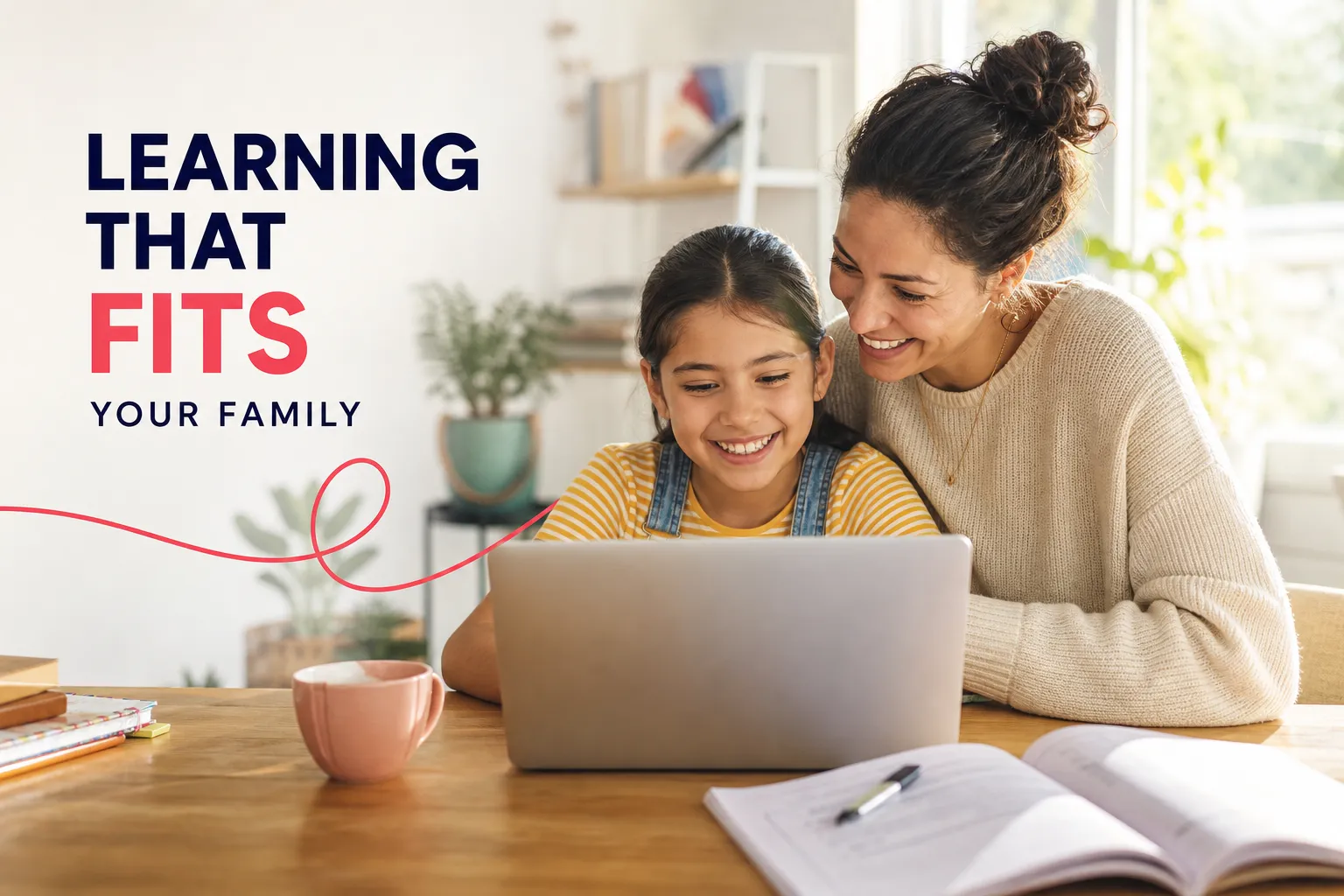
The moment it happens is rarely dramatic. It might be a Sunday evening when your child starts dreading the week ahead, or a parent-teacher meeting where you realise the system is built for thirty children at once and yours is not quite fitting the mould. The benefits you've half-heard about start to feel worth investigating properly. And so, at some point, you find yourself reading articles like this one, caught between genuine curiosity and the quiet anxiety that comes with considering a significant change.
That mix of feelings is completely reasonable. Home education has changed enormously over the past decade, moving well beyond kitchen tables and photocopied worksheets into structured, accredited programmes delivered by qualified specialists. At CambriLearn, an accredited online school operating across more than 100 countries, we hear the same opening questions from almost every family: will my child fall behind academically? Will they miss out socially? Can I actually make this work without becoming a subject specialist myself? This article works through those questions using the research, not reassuring generalisations, and gives you the grounding you need to make a confident, informed decision.
What the academic research actually shows about homeschooling advantages
Most parents approaching home education carry a background assumption that they are taking an academic risk. The evidence, on balance, says otherwise. A 2026 systematic review by Ray, Hoelzle, and Pietersma analysed 24 studies and found that 15 showed a positive academic effect for homeschooled students. Four found no meaningful difference, four were mixed, and one favoured conventionally schooled students. Across reading, language, mathematics, social studies, and science, homeschooled students in that review sat between the 75th and 79th percentile on standardised achievement tests, compared with the public-school average near the 50th percentile. Those advantages held even after controlling for socioeconomic status and racial background.
It is worth being honest about the more cautious findings too. A 2026 research brief from the Coalition for Responsible Home Education noted that once family background factors are controlled for, the maths advantage for homeschooled students may be smaller than headline figures suggest. The research is not a simple story of home education being universally superior. It is a story about conditions. What you do with home education determines what you get from it.
Why structured home education tends to produce strong results
The clearest illustration of this comes from a study by Martin-Chang, Gould, and Meuse, which compared structured homeschoolers, unstructured homeschoolers, and public-school students on standardised tests. Structured homeschoolers scored significantly higher than both other groups, while unstructured homeschoolers performed comparably to their public-school peers. The implication is direct: the home environment alone is not what produces the outcomes. The quality and structure of the teaching, and the qualifications of whoever delivers it, are what make the difference.
What this means for your child's academic future
For parents thinking about university entry, this research matters. A home-educated child taught by qualified specialists, following an accredited curriculum, and assessed through a recognised examination body is not at an inherent disadvantage. The critical variable is not where a child learns. It is how they are taught, and by whom.
Top homeschooling advantages for South African families: personalised learning
A classroom of thirty learners requires one pace, one approach, and one teacher managing all of it simultaneously. Home education removes that constraint. Your child can spend more time on a concept that has not yet clicked, or move ahead in a subject where they have already mastered the material. Surveyed parents and education researchers consistently identify personalised pacing as one of the most significant benefits of homeschooling for children, particularly those who are strong in some areas and still developing in others.
Setting the pace your child actually needs
In practice, learning at the right pace means a child who finds abstract algebra difficult gets more time to work through it before moving on. A child who devours history covers more ground, more deeply. Neither child is held back by the average, and neither is lost in it. The result, for many families, is a learner who is more engaged, less frustrated, and better positioned to retain what they have studied.
Choosing a curriculum that matches your child's goals and your family's life
South African families have more pathway options than most people realise. CAPS, assessed through SACAI, leads directly to a National Senior Certificate recognised by South African universities. The IEB pathway is available for families seeking a premium independent assessment route. For families with international university ambitions, the International British Curriculum* and Pearson Edexcel pathways lead to internationally recognised qualifications. The US K-12 pathway leads to an American High School Diploma, and may support NCAA eligibility for student athletes, subject to meeting specific course and accreditation criteria. CambriLearn offers several of these pathways within a single school, which means families can adjust their curricular direction without switching providers or disrupting their child's learning.
A calmer, safer environment to learn and grow
Not every family arrives at home education through academic disappointment. Many arrive through something more personal: a child who is struggling to cope with the social pressure of a conventional school. Bullying, performance anxiety, and chronic school-related stress are real experiences for a significant number of children, and they are legitimate reasons to consider a different approach.
What the evidence shows about wellbeing and home education
A 2025 systematic review examined 25 studies on social and emotional outcomes for homeschooled children. Sixteen of those studies reported clearly positive outcomes for homeschoolers relative to conventionally schooled peers. Four were mixed, and five found no meaningful difference. No study in the review reported a clear pattern of worse outcomes.
A comparative study from the United Kingdom and Ireland found that school-educated children showed greater psychosocial difficulties than their home-educated counterparts, though the researchers were careful to note that firm conclusions are premature given the methodological limitations of the field. One finding deserves honest acknowledgement: some studies have noted higher reported loneliness among a subset of homeschooled children. The quality and variety of a child's social connections matters, and home education works best when families are deliberate about building those connections.
How a quieter environment affects focus and confidence
Removing the stressors of a large school environment has practical effects that go beyond statistics. Children who are anxious in group settings often concentrate better in a quieter space. Children who learn without the fear of performing in front of peers tend to build genuine confidence more steadily. Short breaks for movement or quiet are easier to take when needed, and the school day can be shaped around when a child is most alert and engaged. For children recovering from difficult school experiences, this shift in environment alone can be transformative.
Stronger family bonds and the freedom to align learning with your values
Families who homeschool consistently report more quality time together. Some of that is structural: the daily school commute disappears, rigid timetables loosen, and learning integrates naturally into daily life. A child studying geography can visit a local historical site. A child learning economics can engage with real household decisions. These are not manufactured teachable moments; they arise when learning and living happen in the same space.
Teaching character and values alongside the curriculum
For many families, the decision to homeschool is partly a decision about formation, not just education. Families with strong religious convictions, cultural traditions, or language preferences find that home education allows them to shape their child's learning within a framework that reflects their values. This looks different for every family, and that variety is one of the genuine strengths of home education done thoughtfully. The point is not that families who send their children to conventional school have weaker values or bonds. It is that home education creates natural, daily conditions for connection that many families find deeply worthwhile.
The socialisation and accreditation questions, answered honestly
These are the two objections that come up in almost every conversation about home education, and they persist because they reflect real, legitimate concerns. They deserve direct answers rather than dismissal.
What the research says about social development in homeschooled children
A population-based study in the United States found no statistically significant differences in social competencies, behaviour problems, depressed mood, or community participation between homeschooled and publicly schooled students. Homeschooled children are not at greater risk of socialisation difficulties. The more useful question is not whether homeschooled children socialise, but how. Sport clubs, community groups, co-operatives, faith communities, and online learner communities all serve this role effectively. The quality of a child's social relationships matters considerably more than the number of hours spent in a school building.
Getting the qualification piece right from the start
In South Africa, home education is legal and clearly regulated. Under the BELA Act of 2024, parents must register with the Head of Department at their provincial education department before or when they start home education. The application requires a credible educational programme, relevant supporting documents, and evidence that the learner's progress will be adequately assessed. For learners in Grades 10 to 12 who want a matric qualification, enrolment with an approved assessment institution is required. SACAI administers the CAPS pathway, which issues an Umalusi-accredited National Senior Certificate. The IEB offers an independently assessed NSC. Getting this right at the outset avoids significant complications later. For international qualifications, accreditation by a recognised body such as Cognia or Pearson Edexcel is what gives the qualification genuine standing with universities globally.
How to combine the homeschooling advantages you want with real academic structure
The question most parents arrive at eventually is a practical one: "I am not a specialist teacher. How do I give my child genuinely excellent subject teaching across every area of the curriculum?" For a growing number of families exploring the pros and cons of homeschooling, the answer is an accredited online school that provides the structure of formal education within the home environment.
CambriLearn is an accredited online private school serving learners aged 4 to 19 across more than 100 countries. According to CambriLearn, lessons are live and teacher-led, running on a structured weekly timetable, with each subject taught by a degree-qualified specialist. Learners attend scheduled classes, have direct access to their teachers, and participate in weekly Q&A sessions. The model is designed to deliver the structure and academic accountability of a conventional school within a home education setting.
What live, teacher-led home education looks like in practice
A typical CambriLearn school week follows a set timetable of live lessons, with support available between classes through direct messaging. CambriCommunity connects learners across more than 100 countries through clubs, events, and meetups, which addresses the socialisation question in a practical and meaningful way. CambriLearn reports a 98% university acceptance rate and holds accreditation from Cognia and Pearson Edexcel (Centre No. 94888), along with registration with SACAI and the IEB. Families are encouraged to request current accreditation documentation directly from the school to verify these details.
Starting points for families ready to explore home education
If you are considering home education, the practical starting points are straightforward. Research your provincial registration requirements under the BELA Act 2024, the Department of Basic Education publishes guidance, and your provincial education department can confirm the current process. Decide which curriculum pathway fits your child's goals: CAPS for South African university entry via SACAI, Pearson Edexcel or the International British Curriculum for international university pathways, or US K-12 for an American diploma. Then look for a provider that is formally accredited and employs qualified specialist teachers. If you would like to see what a structured, accredited home education looks like in practice, reach out to the CambriLearn team directly.
The decision is worth taking seriously
The advantages of home schooling covered in this article are grounded in evidence: stronger academic outcomes in structured environments, learning at the right pace for each child, a calmer setting that supports wellbeing, deeper family connection, and access to properly accredited qualifications. Home education is not a fringe choice or an academic gamble. It is a structured, well-researched, and increasingly mainstream path that works when it is approached thoughtfully and supported by qualified teachers.
The next step is a simple one. Look into your provincial registration requirements, compare the curriculum pathways available for your child's stage and goals, and speak to a provider who can walk you through what the day-to-day experience actually looks like. The evidence for these homeschooling advantages is there for parents who want to explore it, and the options available to South African families today are broader and better supported than many people expect. You are clearly the kind of parent who takes this seriously. That, more than anything, is what makes home education work.