
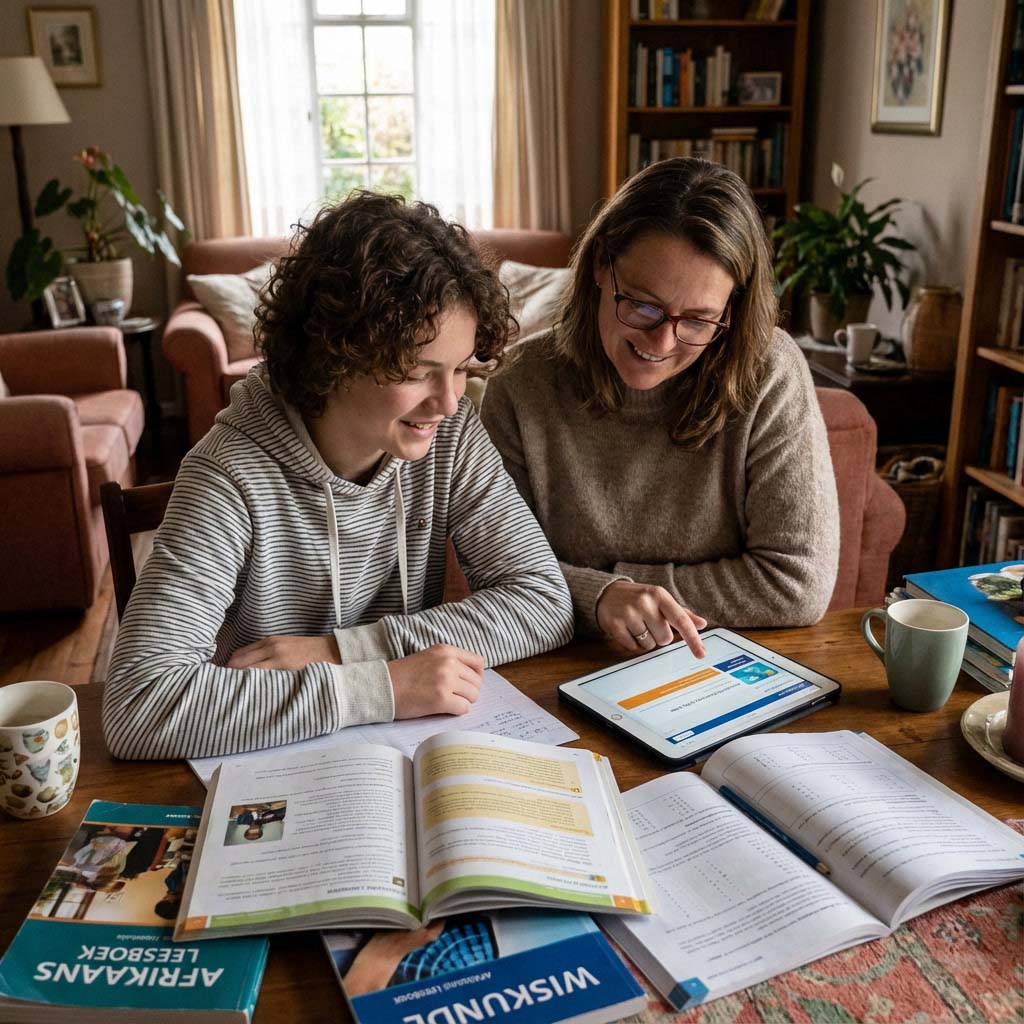
The KABV (Kurrikulum en Assesseringsbeleidsverklaring) is the Afrikaans version of South Africa's national CAPS curriculum, providing mother-tongue education for Afrikaans-speaking learners from Grade R through Grade 9.
For Afrikaans families pursuing homeschooling or distance learning, the KABV curriculum allows children to receive their education in their home language rather than switching to English-medium instruction.
Research consistently shows that children learn more effectively in their mother tongue, particularly during foundational years when literacy and numeracy skills are developing. Online KABV programmes make this option accessible to families regardless of location, removing the geographic limitations that once restricted Afrikaans-medium education to areas with Afrikaans schools.
For many Afrikaans families, language isn't just about communication. It's about identity, culture, and connection to heritage. Education in your mother tongue preserves these connections while providing the strongest foundation for academic success.
What Is the KABV Curriculum
KABV stands for Kurrikulum en Assesseringsbeleidsverklaring, which translates directly to Curriculum and Assessment Policy Statement, the same as CAPS. The content is identical. The difference is language of instruction.
Same Content, Different Language
Everything taught in English-medium CAPS schools is taught in KABV schools, just in Afrikaans. The mathematics concepts are the same. The science content is the same. The learning outcomes are the same. Only the language through which children engage with this content differs.
This matters because KABV isn't a separate or alternative curriculum. It's the national curriculum delivered in Afrikaans. Students following KABV meet the same standards and cover the same material as students in English CAPS programmes.
Grade Coverage
KABV covers the full basic education spectrum:
- Foundation Phase: Grade R through Grade 3
- Intermediate Phase: Grade 4 through Grade 6
- Senior Phase: Grade 7 through Grade 9
For high school (FET Phase, Grades 10 to 12), students transition to matric preparation, which may continue in Afrikaans through appropriate examination pathways or shift to English depending on family choices and available options.
CambriLearn's KABV offering covers Grades 1 through 7, serving Foundation and Intermediate Phase learners with mother-tongue Afrikaans instruction.
Official Recognition
KABV is an official South African curriculum recognised by the Department of Basic Education. It's not an alternative or experimental approach. It's mainstream education delivered in one of South Africa's official languages.
Students completing KABV can transition to any South African high school following CAPS. Their educational foundation is identical to English-medium students, just built in a different language.
Why Mother-Tongue Education Matters
The case for mother-tongue education rests on substantial research evidence, not merely cultural preference.
Cognitive Benefits
Children learn foundational concepts more effectively in their home language. When a child is simultaneously trying to learn to read and learning a new language, cognitive load doubles. Learning to read in a familiar language allows full attention on the reading skill itself.
A landmark 2016 study published in the International Journal of Educational Development examined South African learners and found that students receiving mother-tongue instruction in early grades significantly outperformed those taught in English from the start, even on later assessments conducted in English. The researchers concluded that strong mother-tongue foundations transfer to second-language proficiency rather than competing with it.
This finding challenges the assumption that earlier English instruction produces better English outcomes. The opposite appears true. Children who develop strong literacy in their home language first subsequently learn English more effectively than those pushed into English before their home language literacy is secure.
Conceptual Understanding
Beyond literacy, conceptual learning happens more deeply in familiar language. When a child learns what multiplication means, the concept itself is language-independent. But understanding the explanation, engaging with examples, and asking clarifying questions all happen through language.
A child who fully understands multiplication in Afrikaans has the same mathematical knowledge as a child who understands it in English. The concept transfers. What differs is the depth of initial understanding, which tends to be greater when instruction happens in the child's strongest language.
Confidence and Participation
Children learning in their mother tongue participate more actively. They ask questions more readily. They express confusion more willingly. They engage with content more confidently.
A child struggling to understand both the content and the language of instruction often withdraws. They don't ask questions because formulating questions in a less familiar language is hard. They don't admit confusion because explaining what they don't understand requires language fluency they lack.
This participation difference compounds over years. Active, confident learners develop differently from passive, uncertain ones, regardless of underlying ability.
Cultural Connection
Language carries culture. Afrikaans isn't just a communication tool. It's a connection to literature, history, humour, and ways of understanding the world that don't translate directly into other languages.
Children educated in Afrikaans maintain connection to this heritage. They can read Afrikaans literature in the original. They understand cultural references that require Afrikaans context. They remain part of a linguistic community that spans generations.
For families who value this connection, KABV preserves it in ways English-medium education cannot.
KABV vs English CAPS: Understanding the Differences
The differences between KABV and English CAPS are straightforward but worth clarifying.
What's Identical
- Curriculum content and learning outcomes
- Subject structure and organisation
- Assessment standards and requirements
- Qualification recognition and equivalence
- Progression pathways through basic education
A child completing Grade 6 in KABV has covered exactly what a child completing Grade 6 in English CAPS has covered. The knowledge and skills are equivalent.
What's Different
- Language of instruction (Afrikaans vs English)
- Textbooks and learning materials (Afrikaans versions)
- Teacher communication (in Afrikaans)
- Assessment language (tests and assignments in Afrikaans)
- Literature and language arts content (Afrikaans texts vs English texts)
The language difference is comprehensive. Everything the child reads, writes, hears, and says in their schooling happens in Afrikaans rather than English.
Language Subject Distinctions
In both KABV and English CAPS, students take language subjects:
- Home Language: The primary language of instruction, studied at advanced level
- First Additional Language: A second language studied at intermediate level
For KABV students, Afrikaans is typically the Home Language, with English as First Additional Language. For English CAPS students, the reverse applies.
Both approaches produce students with bilingual capability, just with different primary languages. KABV students develop strong Afrikaans literacy with good English proficiency. English CAPS students develop strong English literacy with good Afrikaans proficiency.
For families weighing curriculum options more broadly, our CAPS curriculum page explains the English-medium option, while comparisons with IEB and British curriculum help families understand the full landscape.
Benefits of Mother-Tongue Education in Afrikaans
Beyond the general case for mother-tongue education, specific benefits apply to Afrikaans-medium instruction.
Preserving Language Vitality
Languages thrive when used across domains, including education. Children educated in Afrikaans develop vocabulary spanning academic, technical, and professional contexts. They can discuss mathematics, science, and history in Afrikaans, not just everyday conversation.
This breadth of capability helps maintain Afrikaans as a fully functional language rather than one restricted to informal contexts. Each generation educated in Afrikaans contributes to the language's continued vitality.
Family Involvement
When children learn in the family's home language, parents can engage meaningfully with education. They can help with homework. They can discuss what children are learning. They can support academic development directly.
Parents whose own English is limited may struggle to help children in English-medium programmes. Concepts they understand perfectly in Afrikaans become inaccessible when explained in English textbooks. KABV keeps parents connected to their children's education.
Learning Efficiency
Children don't waste cognitive resources on language processing when learning in their mother tongue. All their mental energy goes toward understanding content rather than translating between languages.
This efficiency is particularly valuable in early grades when foundational skills require full attention. Learning to read is hard enough without simultaneously learning the language you're reading.
Smooth Transitions
For children from Afrikaans-speaking homes, KABV provides continuity between home and school language environments. There's no jarring shift when school begins. The language of learning matches the language of life.
This continuity supports emotional adjustment to schooling alongside academic development. Children feel comfortable in an environment that sounds like home.
How Online KABV Education Works
Accessing KABV through online schooling makes mother-tongue Afrikaans education available regardless of location.
Lesson Delivery
Online KABV programmes deliver lessons through video instruction in Afrikaans. Teachers explain concepts, demonstrate procedures, and guide learning in Afrikaans throughout. Textbooks, worksheets, and resources are all in Afrikaans.
The experience mirrors Afrikaans-medium traditional schools in language terms while providing the flexibility and accessibility of online education.
Teacher Support
Students access teacher support in Afrikaans. When they have questions, they ask in Afrikaans and receive answers in Afrikaans. This removes the barrier some students face when they understand concepts but can't articulate questions in English.
Support quality matters in any online programme. For KABV specifically, ensure teachers are fluent Afrikaans speakers who can explain concepts clearly in the language, not English speakers working from translated scripts.
Assessment
Tests, assignments, and assessments happen in Afrikaans. Students demonstrate understanding in their strongest language, producing more accurate assessment of actual knowledge rather than assessments confounded by language barriers.
This is particularly important for younger children whose English proficiency is still developing. Assessing a Grade 2 child's mathematics understanding in English may reflect their English ability more than their mathematical knowledge.
Parent Involvement
Online KABV programmes typically expect parent involvement, especially in younger grades. For Afrikaans-speaking parents, this involvement happens naturally in the family language. Parents can read instructions, understand content, and support learning without language barriers.
Our guide on parent involvement in online learning discusses what's typically expected across grade levels.
Grade Levels Available in KABV
Understanding which grades KABV serves helps families plan educational pathways.
Foundation Phase (Grades R to 3)
Foundation Phase focuses on fundamental literacy and numeracy development. KABV Foundation Phase builds these foundations in Afrikaans, establishing reading, writing, and mathematical skills in the mother tongue.
This phase is where mother-tongue instruction matters most. The research evidence for home language instruction is strongest in early literacy development. Children learning to read in Afrikaans develop reading skills that later transfer to English reading with appropriate additional language instruction.
For families with young children, our guide on online primary school covers what to expect at these levels.
Intermediate Phase (Grades 4 to 6)
Intermediate Phase continues mother-tongue instruction while introducing more complex content across subjects. Students build on Foundation Phase skills, developing deeper knowledge in mathematics, sciences, and humanities, all in Afrikaans.
English as First Additional Language receives more attention in Intermediate Phase, developing bilingual capability while maintaining Afrikaans as the primary learning language.
Senior Phase (Grades 7 to 9)
Senior Phase completes basic education, preparing students for FET Phase (high school) studies. Content complexity increases substantially, with subject-specific knowledge deepening across the curriculum.
CambriLearn's KABV offering covers through Grade 7, providing Foundation through early Senior Phase in Afrikaans.
FET Phase Considerations
Grades 10 to 12, the FET Phase leading to matric, present transition decisions for KABV students. Options include:
- Continuing in Afrikaans through schools offering Afrikaans matric
- Transitioning to English-medium for high school
- Combinations where some subjects continue in Afrikaans while others shift to English
By Grade 10, students have strong Afrikaans literacy foundations and developed English proficiency through years of First Additional Language study. The transition to English-medium, if chosen, builds on solid bilingual foundations rather than starting from scratch.
Our guide on Grade 10 subject choices helps families think through high school decisions regardless of curriculum language.
Who Should Consider KABV
KABV suits specific family situations particularly well.
Afrikaans Home Language Families
If Afrikaans is your family's primary language, KABV provides educational continuity with home language. Your children learn in the language they think in, dream in, and feel most comfortable expressing themselves in.
This is KABV's primary audience: families where Afrikaans is genuinely the home language rather than a school subject.
Families Valuing Afrikaans Heritage
Some families prioritise maintaining strong Afrikaans capability across generations. Even in bilingual homes, deliberately choosing Afrikaans-medium education supports language maintenance.
This is a cultural choice as much as an educational one. KABV serves families who want their children fluent and literate in Afrikaans, not merely conversational.
Families in Areas Without Afrikaans Schools
Not all areas have accessible Afrikaans-medium schools. Families in predominantly English areas, rural locations without nearby Afrikaans schools, or even overseas locations may lack traditional KABV options.
Online KABV removes geographic constraints. Afrikaans-medium education becomes available anywhere with internet access.
Homeschooling Families Wanting Structure
Some homeschooling families want curriculum structure without creating everything themselves. KABV through an online school provides structured Afrikaans education with professional lesson delivery and support.
This combines homeschooling flexibility with curriculum guidance, reducing the preparation burden on parents.
Resources and Support for KABV Families
Successful KABV education requires appropriate resources and support systems.
Curriculum Materials
KABV uses Afrikaans textbooks and resources aligned with curriculum requirements. Your online school typically provides or specifies required materials. Ensure you understand what's provided versus what you need to obtain separately.
Quality Afrikaans educational materials exist but may be less readily available than English equivalents. Schools experienced with KABV know where to source appropriate resources.
Supplementary Resources
Beyond core curriculum materials, consider:
- Afrikaans reading books appropriate to your child's level
- Educational websites and applications in Afrikaans
- Afrikaans media (appropriate television, podcasts, videos)
- Library access for Afrikaans children's literature
Immersion in Afrikaans beyond formal lessons reinforces language development and maintains engagement with Afrikaans culture.
Community Connections
Connecting with other KABV families provides mutual support and social opportunities. Look for:
- Homeschool groups serving Afrikaans families
- Online communities for KABV parents
- Local Afrikaans cultural organisations
- Church or community groups using Afrikaans
These connections benefit both parents (sharing experiences and advice) and children (peer relationships with other Afrikaans-speaking children).
Teacher Quality
In any online programme, teacher quality matters enormously. For KABV specifically, teachers must be genuinely fluent Afrikaans speakers who can explain complex concepts clearly in Afrikaans, not just read translated scripts.
When evaluating programmes, ask about teacher qualifications and language backgrounds. Request sample lessons to assess Afrikaans instruction quality directly.
Transitioning Between KABV and Other Curricula
Family circumstances change. Understanding transition options provides flexibility.
KABV to English CAPS
Students can transition from KABV to English CAPS at any grade level. The curriculum content is identical, only the language differs.
The transition involves:
- Adjusting to English as instruction language
- Building English academic vocabulary across subjects
- Adapting to English-medium assessment
Students with strong KABV foundations and developed English Additional Language skills typically handle this transition well. The conceptual knowledge transfers; only the expression language changes.
Younger students generally transition more easily than older ones. A Grade 4 transition is simpler than a Grade 8 transition because less subject-specific English vocabulary needs catching up.
KABV to International Curricula
Transitioning from KABV to Cambridge/British curriculum or American curriculum involves both language and content adjustments. International curricula are English-medium and may sequence content differently from CAPS.
This transition is more substantial than KABV to English CAPS, but achievable with appropriate support and realistic expectations about adjustment periods.
English to KABV
Students can also transition into KABV from English-medium education. This suits families relocating, changing educational preferences, or choosing to strengthen Afrikaans capability.
The transition requires Afrikaans proficiency sufficient for academic work. A child with conversational Afrikaans but limited Afrikaans literacy may need support developing academic language skills.
Planning Transitions
If you anticipate transitions, plan ahead. Strengthen the target language before switching. Understand what content adjustment might be needed. Communicate with both current and future schools about transition support.
Rushed, unplanned transitions create more difficulty than thoughtfully prepared ones.
Frequently Asked Questions
Can my child do KABV if Afrikaans is our second language at home?
Technically yes, but consider whether it serves your child's interests. KABV benefits children for whom Afrikaans is genuinely their strongest language. If your family speaks mostly English with some Afrikaans, your child may struggle with Afrikaans-medium instruction rather than benefiting from it. The mother-tongue advantage applies when instruction happens in the child's actual strongest language. If your child thinks and expresses themselves most naturally in English, English-medium education likely serves them better even if you want them to develop Afrikaans. Consider whether strong Afrikaans is a goal you're pursuing for cultural reasons or whether Afrikaans is genuinely your child's primary language.
Will my child's English suffer if they do KABV?
Research suggests the opposite. Children with strong mother-tongue foundations typically develop better second-language proficiency than those pushed into second-language instruction before their first language is secure. KABV includes English as First Additional Language, developing English skills progressively throughout primary school. By the end of Grade 7, KABV students have substantial English capability alongside their strong Afrikaans. The question isn't whether they'll learn English but whether Afrikaans or English serves as the primary foundation. For Afrikaans home language children, building on the Afrikaans foundation while developing English as additional language produces the strongest bilingual outcomes.
What happens after Grade 7 if my child has followed KABV?
After completing KABV through Grade 7, students have several options for Grades 8 to 12. They can continue in Afrikaans through schools offering Afrikaans-medium Senior Phase and FET Phase. They can transition to English-medium CAPS, building on their strong foundations and developed English Additional Language skills. They can pursue international curricula like Cambridge or American programmes if family circumstances warrant. The transition to English-medium at this point, if chosen, is manageable because students have developed substantial English capability through years of Additional Language instruction while maintaining strong Afrikaans literacy. Their conceptual knowledge in all subjects transfers regardless of which language they continue studying in.