Cognia-accredited online school
CAPS, International GCSE and A Level, US K-12
Homeschooling is legal in Namibia, but only with the Ministry of Education's approval. The Basic Education Act 2020 requires parents to register a child for home schooling, and the ministry is the only body that can approve it.
This guide covers the law, how registration works, the NSSCO and NSSCAS exams, CAPS and international options, costs, and university entry in Namibia and South Africa.
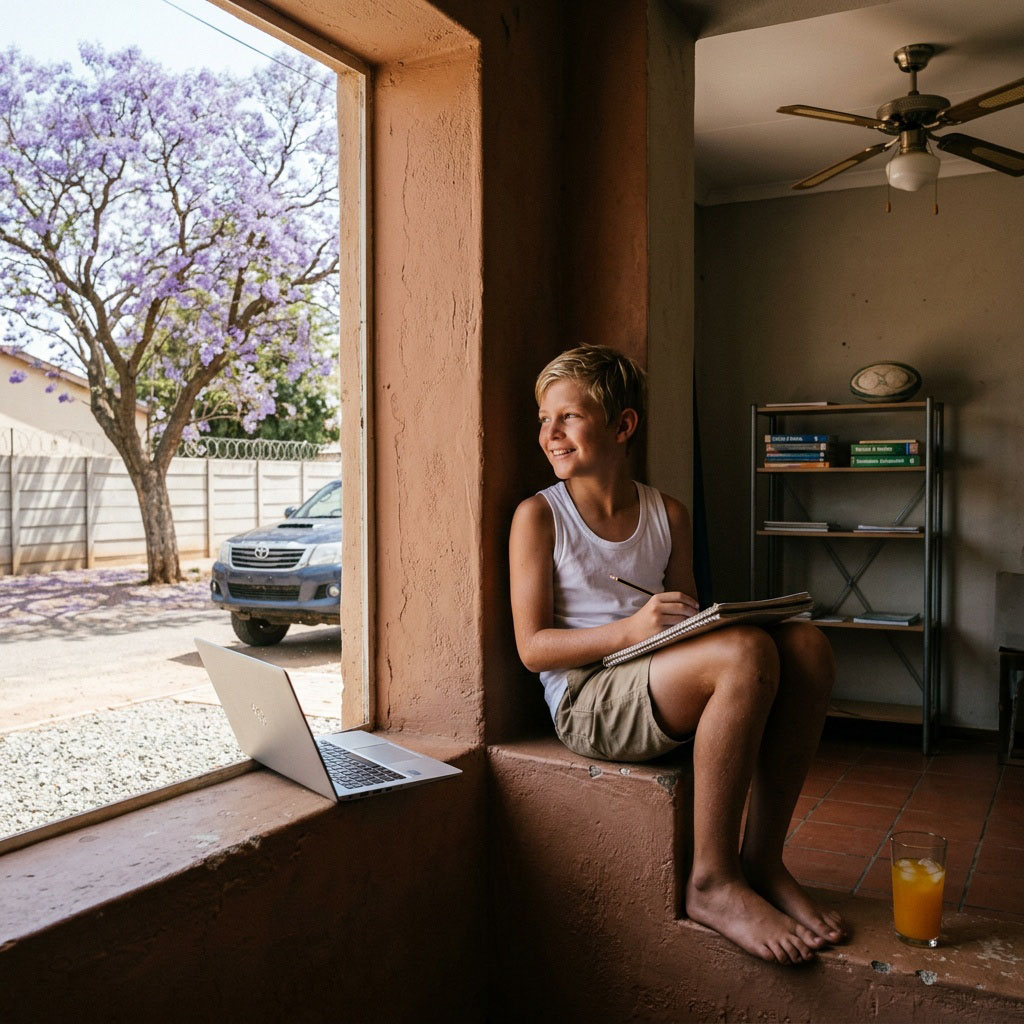
Yes, with approval. The Basic Education Act 3 of 2020, in force since 5 October 2023, lets parents register a child for home schooling with the Ministry of Education.
| Basic Education Act 2020 | What it says |
|---|---|
| Section 1, definition | Home schooling is instruction in which parents, care-givers or privately appointed tutors or service providers teach a learner a legally approved academic curriculum at home instead of at a public or private school |
| Section 9 | School attendance is compulsory from the first school day of the year a child turns 6 until the last school day of the year they turn 18, or until they finish secondary school |
| Section 18 | Parents must apply to register a child for home schooling no later than 10 school days after the school year starts, or the day the child turns 6. A child taken out of school must be enrolled elsewhere, or have a home schooling application made, within 14 days |
| Section 87 | The Minister may register a learner for home schooling on health or disability grounds, or where it's in the learner's best interest. Registration can also be approved where the education will meet the minimum requirements of the State school curriculum at a standard not inferior to State schools, and it can be withdrawn if the requirements aren't met |
| Section 48 | The ministry's quality assurance officers monitor and evaluate all schools, including home schools |
In December 2025 the ministry said the Homeschooling Association of Namibia (HSAN) is neither registered nor recognised by it, and has no authority to approve, register or advise on home schooling. Parents must apply directly to the ministry, and failing to register is non-compliance with the Act.
The ministry also says home schooling means teaching your own children. Teaching children from other families in one place counts as running a private school, which must be registered separately.
Apply directly to the Ministry of Education. No association, centre or online school can register a child on your behalf.
The ministry's December 2025 statementLodge the application no later than 10 school days after the school year starts, or by the day your child turns 6. If you take a child out of school during the year, apply within 14 days.
The Act requires a legally approved academic curriculum, and the ministry weighs whether the education meets State school standards. A ministry director has said the people teaching should hold qualifications equivalent to teachers of the same subjects, so ask what the ministry expects before you apply.
Registered home schools can be visited by the ministry's quality assurance officers, and registration can be withdrawn if the requirements aren't met.
If a home schooling registration is cancelled, the child must be enrolled at a school within 14 days.

Homeschooled students in Namibia can sit the national NSSCO and NSSCAS as part-time candidates, write the South African NSC through CAPS, or take international qualifications.
| Qualification | Awarded by | How homeschoolers sit it | Used for | At CambriLearn |
|---|---|---|---|---|
| NSSCO (Grade 11) and NSSCAS (Grade 12) | Ministry of Education, through DNEA | As a part-time candidate registered at an examination centre, with exams from September to November | UNAM and other Namibian institutions | Not offered |
| National Senior Certificate (CAPS) | Umalusi, with exams set by SACAI | Grades 10 and 11 assessed online at home, Grade 12 finals at a centre in South Africa | South African universities, and UNAM on its evaluation scale | Taught on CAPS, billed in rand |
| Cambridge International GCSE, AS and A Level | Cambridge International | As a private candidate at a centre that accepts them | UNAM on its evaluation scale, and universities abroad | Taught on the International British Curriculum |
| Pearson Edexcel International GCSE and A Level | Pearson Edexcel | As a private candidate at a Pearson centre that accepts them | UNAM on its evaluation scale, and universities abroad | Taught on the Pearson Edexcel pathway |
| American High School Diploma | Score Academy Online, a Cognia-accredited school | Enrolled with the school and assessed online | US colleges | Through sister school Score Academy Online on the US K-12 pathway |
Part-time candidates register with the Directorate of National Examinations and Assessment (DNEA) at a school examination centre each year, and in 2026 registration ran from 26 January to 13 March. Candidates have been asked for ID, previous results and proof of tuition registration with NAMCOL or another approved centre.
CambriLearn CAPS students write their Grade 12 finals at an approved centre in South Africa, so plan to be there for the October and November exams. Our exam centres page lists centres in Namibia that accept private candidates for Cambridge and Pearson exams.
At UNAM, degree entry needs NSSCO and NSSCAS results together, and other recognised school-leaving qualifications, including A Levels and the NSC, are evaluated on the university's own scale. Applicants who didn't complete their previous qualification at UNAM need a recent evaluation certificate from the Namibia Qualifications Authority (NQA).
South African universities accept the CAPS National Senior Certificate as their own school-leaving certificate. For NSSC or A Level results, the Matriculation Board of Universities South Africa decides whether they meet degree entry. UK universities accept A Levels through UCAS, and the American High School Diploma supports applications to US colleges.
The Namibian dollar is pegged one to one with the rand, so CambriLearn's CAPS fees in rand cost the same in Namibian dollars.
See every fee on the pricing page| Grade and curriculum | Package | Per month, 10 instalments | Per year, paid upfront |
|---|---|---|---|
| CAPS Grades 1 to 3 | Starter, 4 subjects | R868.48 | R7,360 |
| CAPS Grades 4 to 6 | Standard, 6 subjects | R2,924.04 | R24,780 |
| CAPS Grades 7 to 9 | Premium, 9 subjects | R4,885.20 | R41,400 |
| CAPS Grades 10 to 12 | Standard, 7 subjects | R4,443.88 | R37,660 |
| International GCSE | Standard, per subject | $66.67 | $565 |
| AS or A Level | Standard, per subject | $71.39 | $605 |
Paying for the year upfront costs 15.25% less than ten instalments. A once-off registration fee applies to new enrolments. CAPS Grade 12 registration and exam fees are paid upfront at enrolment, on top of course fees, and Cambridge and Pearson exam entries are paid to the exam centre. CambriCommunity clubs, events and meetups come with every enrolment, and CambriLearn families in Namibia get up to 20% off at Virgin Active.
Per year figures are the 2026 fees paid upfront, and monthly figures are the same fees paid in ten instalments. Premium International GCSE and A Level packages, KABV, IEB, Primary, Lower Secondary and US K-12 fees are on the pricing page.
If your question isn't here, a consultant can take you through your options in a fifteen-minute call.
Book a free consultationYes, with the Ministry of Education's approval. The Basic Education Act 2020 requires parents to register a child for home schooling, and the ministry is the only body that can approve it.
No later than 10 school days after the school year starts, or by the day your child turns 6. If you take a child out of school, you must enrol them elsewhere or apply for home schooling within 14 days.
No. In December 2025 the ministry said HSAN is not registered or recognised by it and has no authority to approve, register or advise on home schooling. Apply directly to the ministry.
Not as a home school. The ministry says home schooling means teaching your own children, and teaching children from other families in one place counts as running a private school, which must be registered.
Yes, as part-time candidates registered with the Directorate of National Examinations and Assessment at an examination centre. In 2026, registration ran from 26 January to 13 March, with exams from September to November.
Grade 12 finals are written at an approved centre in South Africa, so students need to be there for the October and November exams. Grades 10 and 11 are assessed online at home.
UNAM evaluates recognised school-leaving qualifications, including A Levels and the NSC, on its own evaluation scale. Applicants who studied elsewhere need a recent NQA evaluation certificate.
No. The Namibian dollar is pegged one to one with the rand, so CAPS fees in rand cost the same in Namibian dollars.
CAPS fees start at R868.48 a month for Grades 1 to 3. International GCSE subjects on the Standard package cost $565 a year each when paid upfront.
Fifteen minutes, no obligation. Tell us your child's age, where you live in Namibia and whether they're aiming for UNAM, South African or overseas universities, and a consultant will recommend a pathway and take you through the fees.
Rated 4.8 out of 5 from 386 reviews across Google, HelloPeter, Trustpilot and Facebook, last checked 10 September 2026.
This guide summarises the Basic Education Act 3 of 2020, statements from Namibia's Ministry of Education, and current information from DNEA, NAMCOL, UNAM and Universities South Africa. It is general information rather than legal advice, so check current requirements with the Ministry of Education before you apply. Last checked 26 September 2026. CambriLearn is Cognia-accredited and an approved Pearson Edexcel centre, and CAPS students are registered with SACAI. The US K-12 pathway is delivered through sister school Score Academy Online, which is Cognia-accredited and offers NCAA-approved courses. CambriLearn is not a registered Cambridge school and is not affiliated with Cambridge Assessment International Education.
