
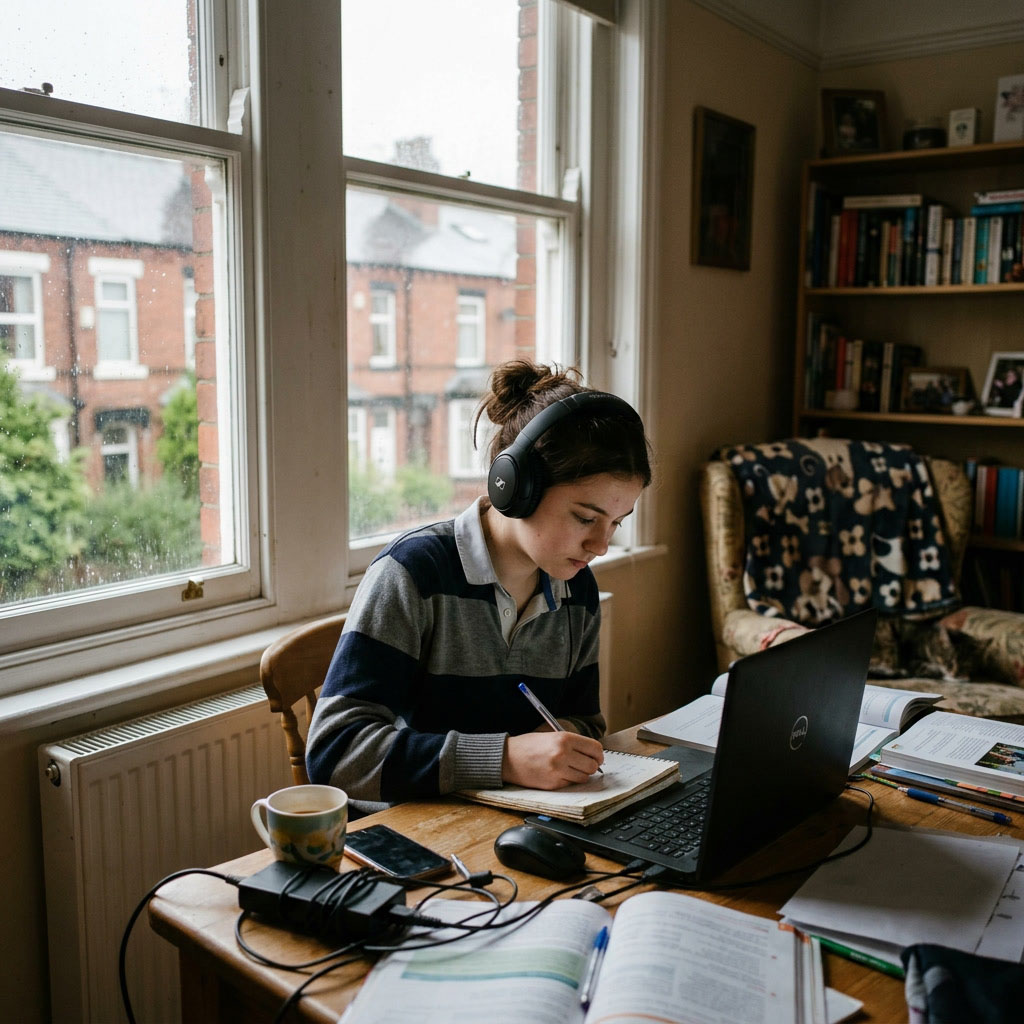
An online school in the UK is a full educational provider that delivers the British curriculum remotely, with live lessons, recorded content, qualified teachers, and the same recognised qualifications students would earn at a traditional school. Most online schools deliver IGCSE and A Level (or AS Level) qualifications through Cambridge International or Pearson Edexcel, with students sitting their final exams at approved exam centres such as British Council offices or registered schools. The model suits families looking for flexibility, families living abroad who want their child to keep studying the British curriculum, students who haven't thrived in traditional school settings, and anyone whose circumstances make regular school attendance difficult.
Online schools in the UK aren't a new idea, but the choice available to families has grown substantially over the past few years. Providers vary widely in price, structure, teaching style, and quality, so understanding how the model actually works is the first step in choosing well.
What an Online School Actually Is
An online school delivers the full educational experience remotely. Students log in for live lessons taught by subject specialist teachers, work through recorded content at their own pace, complete assignments, sit internal assessments, and engage with classmates through video discussion and chat. The structure mirrors a traditional school in most respects: there's a timetable, there are teachers, there's a curriculum, there are reports on progress.
What differs is the location and the pace. Students study from home (or anywhere with a reliable internet connection), and they have more control over when they engage with content. Live lessons happen at fixed times, but recorded lessons can be watched when it suits the student. Independent work fits around the family's schedule rather than dictating it. For families with non-standard rhythms, whether because they travel, run businesses with unusual hours, or have children who concentrate better at non-standard times, this flexibility matters.
Online school is distinct from informal home education, where parents take full responsibility for their child's learning without engaging a structured provider. With online school, the school is responsible for teaching, marking, and exam preparation. Parents oversee the daily routine rather than acting as the primary educator.
Qualifications and Curriculum
Most online schools in the UK offer the British curriculum, leading to IGCSE qualifications (typically taken at ages 14-16) and A Levels (at ages 16-18). Some also offer AS Level as an interim qualification.
These qualifications are awarded by Cambridge International and Pearson Edexcel, the two major exam boards delivering international versions of UK qualifications worldwide. Both are recognised by universities globally, including all UK universities. An IGCSE in Mathematics or an A Level in Chemistry earned through an online school is identical to one earned at a traditional school, in terms of how universities view it and the certificate the student receives.
Some online schools offer the Cambridge curriculum from primary level upwards, including Cambridge Primary, Cambridge Lower Secondary, and Cambridge IGCSE. For families committed to the British curriculum across the full school journey, full-pathway providers offering ages 5 to 18 through programmes such as British curriculum online schooling can be valuable, because they remove the friction of switching providers between primary and secondary.
How Exams Work for Online School Students
This is where online schooling differs most clearly from traditional school. Students at traditional UK schools sit their exams at the school itself; students at online schools register as private candidates and sit their exams at approved exam centres elsewhere.
Approved exam centres include British Council offices, which exist in most countries worldwide, registered Cambridge schools that accept private candidates, and certain other approved venues. Students typically travel to the centre for their written exams during the published exam sessions. Cambridge International runs exam sessions in May/June and October/November. Pearson Edexcel runs three sessions a year: January, May/June, and a smaller October/November sitting.
Online schools support students through this process, helping them register, identifying appropriate exam centres, and providing predicted grades for university applications. Families typically need to factor in exam centre fees, which sit alongside tuition and are paid separately to the centre rather than to the school.
Online School vs Home Education in the UK
These two terms are sometimes used interchangeably, but they refer to different things in the UK context.
Home education (also called elective home education) is when a parent takes legal responsibility for their child's education without using a school. In England, parents have the right to educate their child at home rather than send them to school, set out in Section 7 of the Education Act 1996. The Department for Education's official guidance on elective home education covers parents' responsibilities and the role local authorities play in checking that the education being provided is suitable. Equivalent rules apply in Scotland, Wales, and Northern Ireland, with some variations.
Online school is a structured alternative where a school provider takes responsibility for teaching, even though delivery happens remotely. In legal terms, a child attending an online school registered as a school in the UK is generally considered to be attending school. A child using an online school based abroad is typically classed as electively home educated in the eyes of the local authority, with the online school as the parent's chosen provider rather than a school in the UK legal sense. The distinction matters mainly for record-keeping with the local authority; for the child's actual education and qualifications, it makes no practical difference.
Who Online School Suits
Online school suits a wide range of students and family circumstances. It works well for families living abroad who want their child to study the British curriculum without paying international school fees. It suits students who travel frequently for sport, performance, or family reasons. It supports students who have struggled with anxiety, bullying, or sensory difficulties in traditional school settings, and accommodates students who learn faster or slower than the standard pace.
It also suits older students who didn't get the GCSE or A Level grades they wanted first time round and want to retake without returning to a school environment, students preparing for university while based outside the UK, and athletes or performers whose training schedules don't fit a 9-to-3 school day.
What it doesn't suit is students who need constant adult supervision to focus, or students who actively need the social environment of a classroom to feel motivated. Online school requires a degree of self-discipline that not every 12-year-old has straight away. Good providers build in scaffolding to help students develop these habits, but families considering online school should think honestly about whether their child can work independently for several hours a day, even with structure and support.
What to Look For in a UK Online School
Quality varies widely. When evaluating an online school, parents should look at several factors.
Accreditation is the first signal. Look for recognition from established accreditation bodies such as Cognia or the British Schools Overseas inspection framework. Accreditation doesn't guarantee teaching quality, but it does show the provider has been independently reviewed against external standards.
Teacher qualifications matter. Subject specialists with experience teaching at IGCSE or A Level produce better outcomes than general tutors. Look for schools that publish information about their teaching team rather than treating it as a black box.
Class structure is worth understanding. Some providers run small live classes with regular interaction; others rely heavily on pre-recorded content with limited live contact. Both can work, but they suit different learners. Ask specifically how many live lessons a week a student gets in each subject, and how the recorded content is structured.
Exam centre support can make or break the practical experience. The administrative side of registering as a private candidate, paying fees, and travelling to a centre is a real workload, and good schools provide substantial support with it. Ask how the provider supports families through registration and centre selection.
Pricing transparency is essential. Tuition fees vary widely between providers, and additional costs (exam fees, textbook costs, technology requirements, exam centre fees) can add substantially to the headline figure. A clear breakdown of what's included matters when families are comparing options for online A Levels in the UK or any other British curriculum programme.
FAQs
Is online school legal in the UK?
Yes, online school is legal across the UK, though the legal framework varies between nations. In England, parents have the right under Section 7 of the Education Act 1996 to educate their child otherwise than at school. A child using an online school based outside the UK is typically considered electively home educated in legal terms, with the parent taking formal responsibility and the online school acting as the chosen provider. Scotland, Wales, and Northern Ireland have similar provisions with some variations. Parents generally need to notify their local authority (or equivalent) if they're withdrawing a child from a registered school, but they don't need permission to choose online schooling for a child who has never been registered at a UK school.
How much does online school in the UK cost?
Tuition fees vary considerably, typically ranging from around £2,000 to over £8,000 per year for full-time enrolment, depending on the provider, the year group, and the level of teacher contact. Single-subject options for students wanting just one or two A Levels alongside other study are often available at lower per-subject prices. On top of tuition, families need to budget for exam fees (paid to the exam centre, typically £100 to £200 per IGCSE or A Level subject), exam centre fees (an additional venue charge that varies by location), textbooks, and reliable technology. Always ask providers for a full breakdown including all add-on costs before committing.
Will universities accept students who attended an online school?
Yes. UK universities, US universities, and universities worldwide accept students who completed their qualifications through accredited online schools on exactly the same terms as students from traditional schools. Universities look at the qualification (the IGCSE, A Level, or equivalent), the grade, and the awarding body. They do not penalise students for the mode of study, and the certificate doesn't indicate where the student physically attended classes. Universities do typically want predicted grades and a school reference, both of which online schools provide. Competitive courses such as medicine and Oxbridge applications work the same way for online students as for any other applicant, with the predicted grades, personal statement, and admissions tests carrying the most weight.