
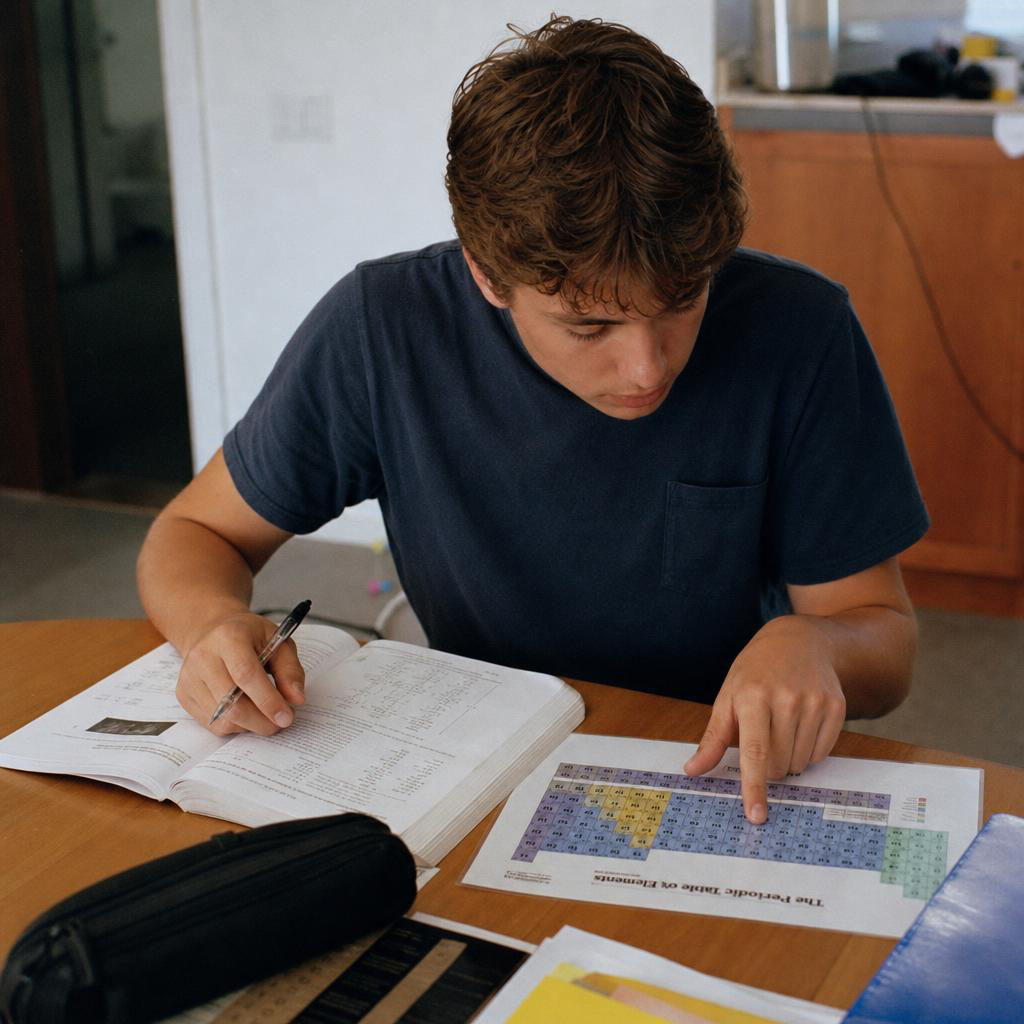
Online A Level Chemistry covers physical chemistry, organic chemistry, and inorganic chemistry across two years of study, with the practical content assessed through written examinations rather than school-based laboratory work. The qualification follows the same syllabus and sits the same external papers as A Level Chemistry studied at a traditional sixth form. Universities accept online A Level Chemistry for Medicine, Pharmacy, Chemical Engineering, Chemistry, and many other quantitative science degrees.
Chemistry is one of the most demanding A Levels academically, and the online route works best for students with strong mathematical confidence and a willingness to engage with abstract concepts. Here's what the course covers and what to expect.
What A Level Chemistry Covers
The A Level Chemistry syllabus is built around three interconnected areas: physical chemistry, organic chemistry, and inorganic chemistry. The three areas are studied alongside each other rather than as sequential blocks, with students developing knowledge in all three over the two years.
Physical chemistry covers atomic structure, bonding, energetics, kinetics, equilibria, redox chemistry, electrochemistry, and acid-base chemistry. This is the area where chemistry connects most directly to mathematics and physics, with calculations and quantitative reasoning forming a substantial part of the work.
Organic chemistry covers the chemistry of carbon-containing compounds: alkanes, alkenes, alcohols, halogenoalkanes, carboxylic acids, esters, amines, and aromatic compounds. Students learn reaction mechanisms, synthesis pathways, and the principles of how organic molecules behave. This is the area many students find most accessible because it has clear patterns and rules.
Inorganic chemistry covers the chemistry of the elements, particularly the periodic trends, the chemistry of specific groups (Groups 2, 7, transition metals), and applications of inorganic compounds. Students learn how chemical properties vary across the periodic table and why.
Across all three areas, students develop quantitative skills: mole calculations, calculations involving concentration, energy calculations, equilibrium calculations, and pH calculations. Chemistry at A Level is mathematical to a significant degree, and students who struggle with the underlying maths often struggle with chemistry too.
For students taking the Pearson Edexcel International Advanced Level route, the modular structure spreads content across six units. Cambridge International A Level Chemistry uses a different structure with comparable coverage.
How A Level Chemistry is Examined
A Level Chemistry is examined through written papers covering theoretical content, applications, and practical skills.
Cambridge International A Level Chemistry uses five papers: multiple choice, structured questions, an advanced practical skills paper, a structured essay paper, and a planning, analysis and evaluation paper. The papers progressively test knowledge, application, and experimental reasoning.
Pearson Edexcel International A Level Chemistry uses six unit papers across the two years. The papers include multiple choice, short-answer, and longer structured questions covering all three branches of chemistry plus practical-themed questions.
Both routes assess practical skills primarily through written exam questions rather than through coursework. Students study experimental techniques, observation and measurement, and data analysis theoretically, then answer practical-themed questions in their exam papers. This is what makes online study viable for sciences.
The Practical Component for Online Students
The practical assessment in A Level Chemistry covers experimental techniques (titrations, observations, separation methods, organic synthesis steps), interpretation of results, and evaluation of methods. Online students develop competence in these areas without needing access to a school lab.
Video demonstrations show titrations being performed, organic syntheses being carried out, and analytical techniques being applied. Students see what equipment looks like, how it's used, and what observations to expect.
Detailed study of experimental method teaches students why specific techniques are used. Why is a burette filled in a specific way? Why does a particular reaction need to be heated under reflux? Why is purity assessed by melting point? Understanding the reasoning behind techniques is what the exam questions actually test, not the physical dexterity of performing them.
Extensive past paper practice on practical-themed questions develops the specific exam skills students need. The format of these questions is consistent year to year, so students who practise them thoroughly become familiar with what's expected.
For students who want some hands-on chemistry experience to supplement online study, simple experiments can be done at home (with appropriate safety) using accessible chemicals: acid-base indicators, simple crystallisations, observation of physical changes. These don't replace the structured laboratory work of a school course, but they can help with intuition for chemical behaviour.
The CambriLearn A Level programme handles science practicals through this combination of video, theoretical study, and exam-focused practice.
Who A Level Chemistry Suits
A Level Chemistry suits students who can handle abstract concepts, are comfortable with mathematical calculations, and have the patience to develop deep understanding of how chemical systems behave. The subject rewards careful, systematic learning over time rather than late cramming.
It's particularly important for several degree pathways. Medicine almost always requires A Level Chemistry. Pharmacy, Chemical Engineering, and Chemistry degrees require it. Veterinary Science usually requires it. Dentistry often requires it. Many biological science degrees prefer it, even if Biology is the listed essential. Materials Science, Geology, and Environmental Science often expect it. The Royal Society of Chemistry's careers guidance gives a fuller picture of the range of fields chemistry feeds into, which is broader than most students expect.
For students whose intended degree doesn't explicitly require Chemistry, the question is whether it strengthens their application. A student aiming at Medicine should take it. A student aiming at Mathematics or Computer Science generally doesn't need it. A student aiming at Engineering may or may not need it depending on the specific engineering discipline.
A reasonable preparation point is achieving a strong grade at IGCSE Chemistry (grade A or 7 and above) and being mathematically confident at IGCSE Mathematics level. Students with weaker maths preparation often struggle with A Level Chemistry calculations, even if they understand the underlying chemistry conceptually.
The step up from IGCSE Chemistry to A Level Chemistry is substantial. Topics are covered in greater depth, calculations become more complex, and the level of abstraction increases significantly. Students should expect the first months of A Level Chemistry to feel harder than IGCSE, even with strong prior preparation.
Chemistry Alongside Other Science Subjects
A Level Chemistry is often taken with Biology, with Physics, or with both. The most common combinations are Biology and Chemistry (for medical and biological science pathways), Chemistry and Physics (for engineering and physical science pathways), and all three sciences (sometimes with mathematics added).
Triple sciences plus Mathematics is sometimes appropriate for students aiming at very competitive science degrees, but it's a heavy workload. Most students do better with three subjects studied thoroughly than four subjects spread thinly. The exception is students taking Chemistry alongside Maths and Further Maths for Chemical Engineering or Chemistry at Cambridge.
For students wondering about subject combinations, the practical advice is to research the specific universities and courses they're considering. Chemistry combines well with most science and mathematical subjects, and the right combination depends entirely on the intended degree.
Frequently Asked Questions
How difficult is A Level Chemistry compared to other sciences?
A Level Chemistry has a reputation as one of the more demanding A Level subjects, typically considered comparable to Mathematics and Physics in difficulty. Students often find Chemistry harder than Biology because it combines significant factual content with substantial mathematical calculations and abstract conceptual reasoning. The difficulty isn't uniform across the syllabus. Some topics, like organic chemistry reaction mechanisms, have clear patterns that most students can master with practice. Others, like equilibrium calculations or thermodynamics, require deeper conceptual understanding and tend to separate strong students from weaker ones. The honest assessment is that A Level Chemistry requires consistent work throughout the two years. Students who treat it as a subject to revise close to exams typically struggle, while students who build understanding gradually tend to do well.
What mathematical skills are needed for A Level Chemistry?
Strong IGCSE-level mathematics is the minimum. Students need fluency with algebra, manipulation of equations, logarithms, indices, basic calculus (for some topics), and unit conversions. The mathematics in A Level Chemistry isn't conceptually advanced compared to A Level Maths, but it needs to be reliable. Students who hesitate on basic algebra will lose marks on Chemistry calculations even if they understand the chemistry. Strong calculator skills also matter: students need to handle calculations efficiently under exam time pressure. For students whose maths is weaker, taking A Level Maths alongside Chemistry can help, since A Level Maths consolidates and extends the mathematical skills Chemistry needs. Students unsure about their mathematical readiness should discuss this with their provider before starting, since gaps are easier to address before the course begins than partway through.
Do students need access to a chemistry lab at any point during the course?
No, when studying through a recognised online provider with practical-via-written-paper assessment. The Pearson Edexcel International A Level route specifically uses written assessment for the practical component, which is why it works for online students. Cambridge International A Level Chemistry similarly assesses practical skills through written papers. Students complete the full qualification, including all practical assessment, without lab access. That said, some students choose to attend short laboratory courses during school holidays to gain hands-on experience. This isn't required for the qualification, but it can be useful for students considering Chemistry-related degrees, both for personal interest and as something to discuss in university applications. The choice to do so or not doesn't affect the qualification or how universities view it.