 Cognia-accredited online school
Approved Pearson Edexcel centre, International GCSE to A Level
Cognia-accredited online school
Approved Pearson Edexcel centre, International GCSE to A Level
Homeschooling is legal in Indonesia. The 2003 national education law recognises learning at home as informal education, and a 2014 ministry regulation sets out how families run it and register it.
This guide covers the rules, how homeschooled students earn a Paket certificate through a PKBM, the new Academic Ability Test, Cambridge exams in Jakarta, costs, and the routes to university in Indonesia and abroad.
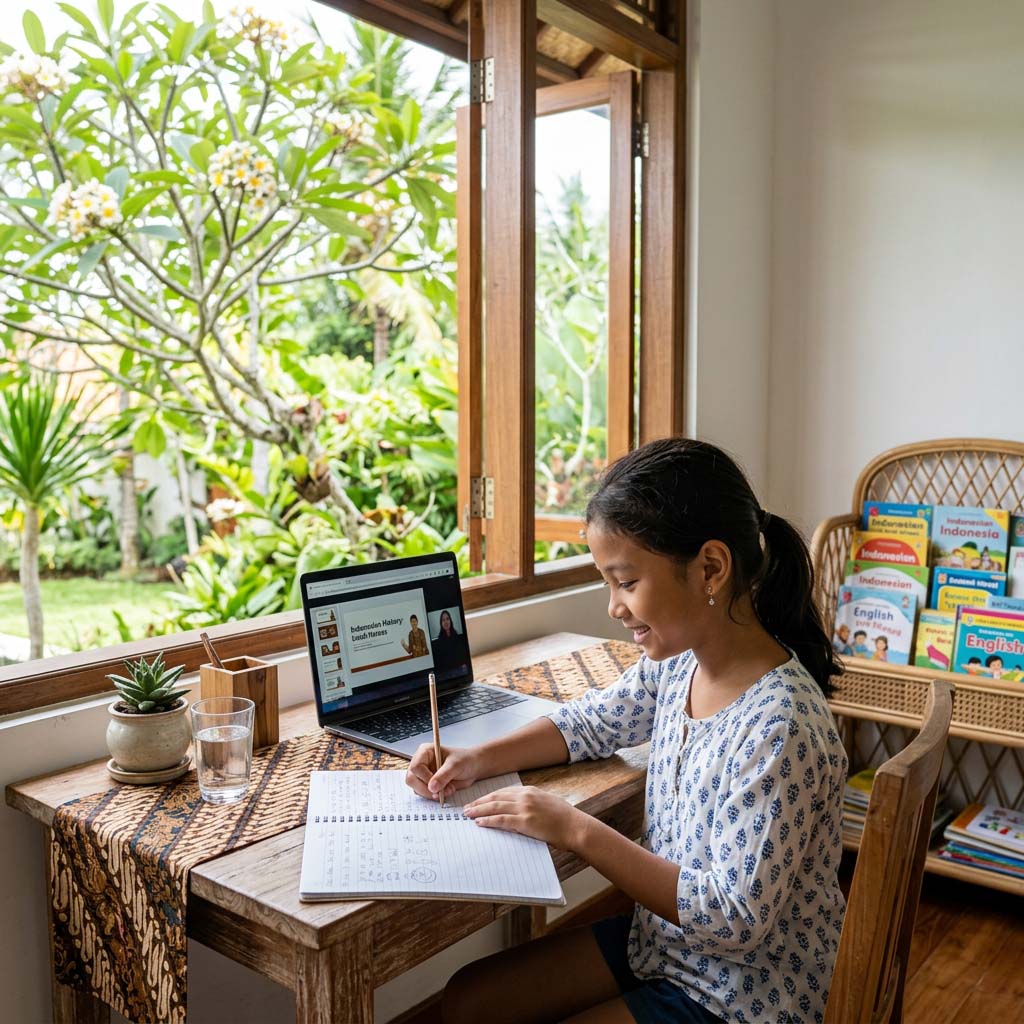
Yes. Indonesian law treats education by the family as one of three recognised pathways, alongside formal schools and non-formal education.
| Law or regulation | What it says |
|---|---|
| UU No. 20/2003 (Sisdiknas), article 13 | Education runs through three pathways: formal, non-formal and informal |
| Sisdiknas, article 27 | Informal education by families and the community takes the form of independent learning, and its results count as equal to formal and non-formal education once the learner passes an assessment against national standards |
| Sisdiknas, article 6 | Every citizen aged 7 to 15 must take part in basic education |
| Permendikbud No. 129/2014 (Sekolahrumah) | Homeschooling can be single-family (tunggal), multi-family (majemuk) or community-based (komunitas). Single-family and multi-family homeschools must register with the district or city education office (Dinas Pendidikan) |
| Permendikdasmen No. 9/2025 (TKA) | The national Academic Ability Test is open to students on the formal, non-formal and informal pathways, including homeschooled students (murid sekolahrumah) |
To register a single-family homeschool, parents give the education office identity documents for themselves and their child, and a signed statement that they are responsible for the child's education. They also provide a written learning programme and, if the child is 13 or older, the child's own statement agreeing to learn at home. The regulation says the curriculum should refer to the national curriculum.
Many homeschooling families report that office registration is rarely enforced. In practice, what matters is enrolling the child at a PKBM (community learning centre), which records them as a learner and issues the Paket certificate.
The duty to take part in basic education applies to Indonesian citizens. Foreign families living in Indonesia aren't covered by it, and many use international schools, known in law as SPK schools, or online schools based abroad.
Indonesian certificates come through a PKBM or SKB. International qualifications are sat as a private candidate at an exam centre.
| Route | Awarded by | How it works | Used for | At CambriLearn |
|---|---|---|---|---|
| Paket A, B and C | The PKBM or SKB where the student is registered | Register as a learner, follow the national curriculum and pass the centre's assessment | Equal to SD, SMP and SMA, with Paket C used for university entry | Not offered |
| Academic Ability Test (TKA) | Ministry of Primary and Secondary Education | A national computer-based test, entered through the student's PKBM or SKB | Standardised results for selection, including SNBP | Not offered |
| Cambridge International GCSE, AS and A Level | Cambridge International | Sat as a private candidate at the British Council Indonesia Foundation or another centre that accepts private candidates | Universities abroad, and Indonesian universities after equalisation | Taught on the International British Curriculum |
| Pearson Edexcel International GCSE and A Level | Pearson Edexcel | Sat as a private candidate at a Pearson centre that accepts them | Universities abroad, and Indonesian universities after equalisation | Taught on the Pearson Edexcel pathway |
| American High School Diploma | Score Academy Online, a Cognia-accredited school | Enrol with the school and complete coursework assessed online | US colleges, and Indonesian universities after equalisation | Through sister school Score Academy Online on the US K-12 pathway |
Paket A is equivalent to primary school (SD), Paket B to junior high (SMP) and Paket C to senior high (SMA). The PKBM or SKB where the learner is registered decides whether they have passed and issues the ijazah.
The TKA, first held in 2025, is open to homeschooled students through their PKBM or SKB. The ministry describes it as optional and not a graduation test. It also says one aim of the TKA is to give students outside formal schools access to recognition of their learning, and state universities use it to check report cards in SNBP.
The British Council Indonesia Foundation in Jakarta enters private candidates for Cambridge International GCSE, AS and A Level exams. For Pearson Edexcel, confirm a centre that accepts private candidates before your child starts a course.
